
The mid-market is seen as the backbone of the economy – yet many companies stumble between routine and risk. Instead of acting strategically, day-to-day operations often dominate. A lack of focus, outdated structures and poor communication slow development and increase risk. This article shows how companies can regain calm, structure and future security through clear priorities, open team communication and pragmatic risk management.
Many mid-market companies are regarded as the backbone of the German economy – reliable, grounded and high-performing. Yet behind this stability there is often a paradox: whilst orders grow and responsibility increases, time for strategy, structure and future planning falls by the wayside. Everyday work becomes a permanent firefighting exercise – and what worked for a long time hits its limits.
This article shows which patterns of thinking and action hold the mid-market back – and how targeted prioritisation, open communication and pragmatic risk management help restore the ability to act. A structured risk check for SMBs is the practical entry point.
Reaction instead of strategy – when everyday life dictates thinking
Many managing directors and owners of small and mid-sized companies are stuck in a cycle of constant problem-solving: delivery delays, staff shortages, technical faults, urgent customer enquiries. Time for overarching planning is rare.
This "firefighter mentality" creates short-term activity – but long-term stagnation. Decisions are made situationally rather than prepared strategically. Projects lose momentum, and the feeling of always being "too late" becomes the norm.
Those who want to grow or remain stable need a change of perspective here: away from reacting, towards shaping. Regular reflection phases – whether in internal workshops or with external sparring partners – create the space needed to break out of reactive patterns.
Lack of focus – how overload destroys productivity
The more tasks are handled at once, the less impact they have. In many businesses, prioritisation is missing: every enquiry is urgent, every task important.
The result is overloaded teams, dwindling motivation and falling quality. It becomes especially critical when operational hustle displaces strategic foresight – for example in workforce planning, investments or preparing for new legal requirements.
Focus means consciously deciding what comes first – and what can wait. Companies that regularly review their processes, clearly define responsibilities and delegate tasks gain not only efficiency but also calm. Structures are not an obstacle; they are the prerequisite for stability.
Old beliefs – when experience becomes a brake
"I don't have time for that", "It's always been that way", "It works differently here" – you hear such phrases frequently in the mid-market. They sound harmless, but they are dangerous. Because they block development.
Many businesses cling to proven routines even when the market, technology or customer requirements have long since changed. Often it is unconscious habits that increase risk: missing documentation, unclear responsibilities or inadequate maintenance.
Change begins with the willingness to question old patterns of thinking. Regular risk and process analyses show where effort arises without bringing benefit – and where simple adjustments can have a big impact.
Residual risk and prioritisation – perfection is not the goal
No company can eliminate all risks. What matters is recognising the most important threats and putting them in a sensible order.
Structured risk management helps make these priorities visible: which issues really threaten the business – financially, organisationally, legally? Where can damage be high even if the probability of occurrence is low?
Practical risk work is not a bureaucratic control instrument, but a tool for better decisions. It shows where prevention pays off – and where accepted residual risk is part of a realistic business routine.
Communication as a key factor – sharing knowledge instead of shifting responsibility
In many businesses, critical knowledge rests with individual people. When they are absent or overloaded, processes grind to a halt.
Open communication and clearly defined responsibilities are therefore central safety factors. Regular team meetings, transparent metrics and respectful handling of feedback ensure that risks are recognised early and solutions developed together.
Especially in family businesses and owner-managed companies, letting go of control in favour of trust can be a decisive turning point: employees who are allowed to take responsibility act with greater engagement and foresight.
Three steps towards greater clarity and security
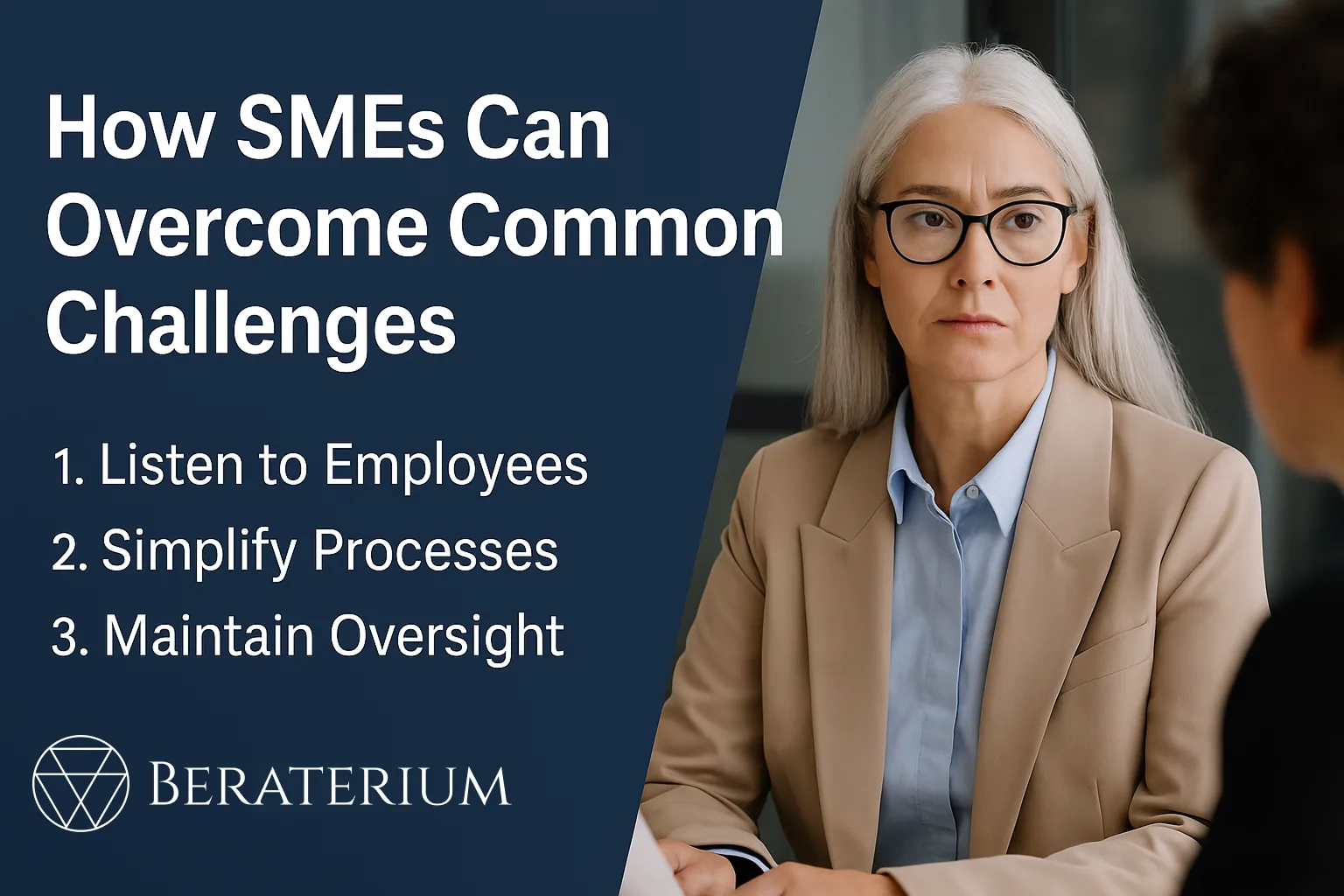
1. Take employees seriously – knowledge does not only sit in the boardroom.
Those who work in the business every day usually know the biggest weaknesses best. Production staff notice irregularities before they lead to failures. Office staff see where processes stall. These perspectives are gold – if you actively seek them out.
Regular conversations, feedback rounds or short weekly meetings help identify problems early and share responsibility. When employees see that their assessments are taken seriously, not only does the quality of input improve, but so does identification with the company. Trust is not built through instructions, but through genuine listening.
2. Simplify processes – complexity is not a sign of professionalism.
Many mid-market businesses struggle with structures that have grown over time: different systems, unclear workflows, missing documentation. That costs time and creates frustration.
The first step towards greater clarity is to make processes visible – for example with a simple overview of all central workflows from order intake to delivery.
Then it is worth asking: "What of this is really necessary?" Often tasks can be combined or simplified digitally. Short checklists, clear responsibilities and traceable workflows create efficiency – and reduce the risk that important tasks get lost in everyday work.
Process clarity is not an end in itself: it gives employees security and the company speed.
3. Keep the overview – make risks visible before they arise.
Risk management does not have to be a thick folder on the shelf. Even a simple overview of possible threats and bottlenecks can be decisive: where could losses occur if a system fails, a supplier drops out or an employee is absent for longer?
A regular risk workshop – internal or with external facilitation – helps collect these points, prioritise them and record concrete measures. What matters is not letting the results disappear into a drawer, but updating them regularly.
Those who make risks transparent gain not only security but freedom to decide: investments become more targeted, responsibilities clearer, and even in a crisis the company remains able to act.
Conclusion: the future needs clarity
The mid-market thrives on commitment, experience and proximity. Yet precisely these strengths can become weaknesses when structures are missing and communication stagnates.
Those who make risks visible do not gain control – they gain freedom. And those who speak openly about problems lay the foundation for sustainable growth – without permanent stress, but with a clear direction.