
Why talk about AI and risks now?
Technology does not replace structured risk assessment — it supports people in setting priorities.
In everyday life and business we use AI more and more often: for texts, images, processes, analysis. At the same time the stance often still holds: "The internet was also such a topic – maybe I don't need it." With AI that is risky. It will not simply disappear. The question is no longer whether, but how we use it – and which risks we take doing so.
For entrepreneurs, founders and SMEs this means: AI can speed processes, cut costs and ease work. But it can also change jobs, promote wrong decisions and cause legal or reputational harm. Whoever deploys AI without keeping people and the overall risk picture in view acts negligently.
People at the centre – also with AI
In companies it is not only about technology. It is about people: they shape, design and change the business. AI and robotics can take over repetitive or physically heavy work – and already do, from production to administration. That relieves, but can also trigger fear: will my job still be needed?
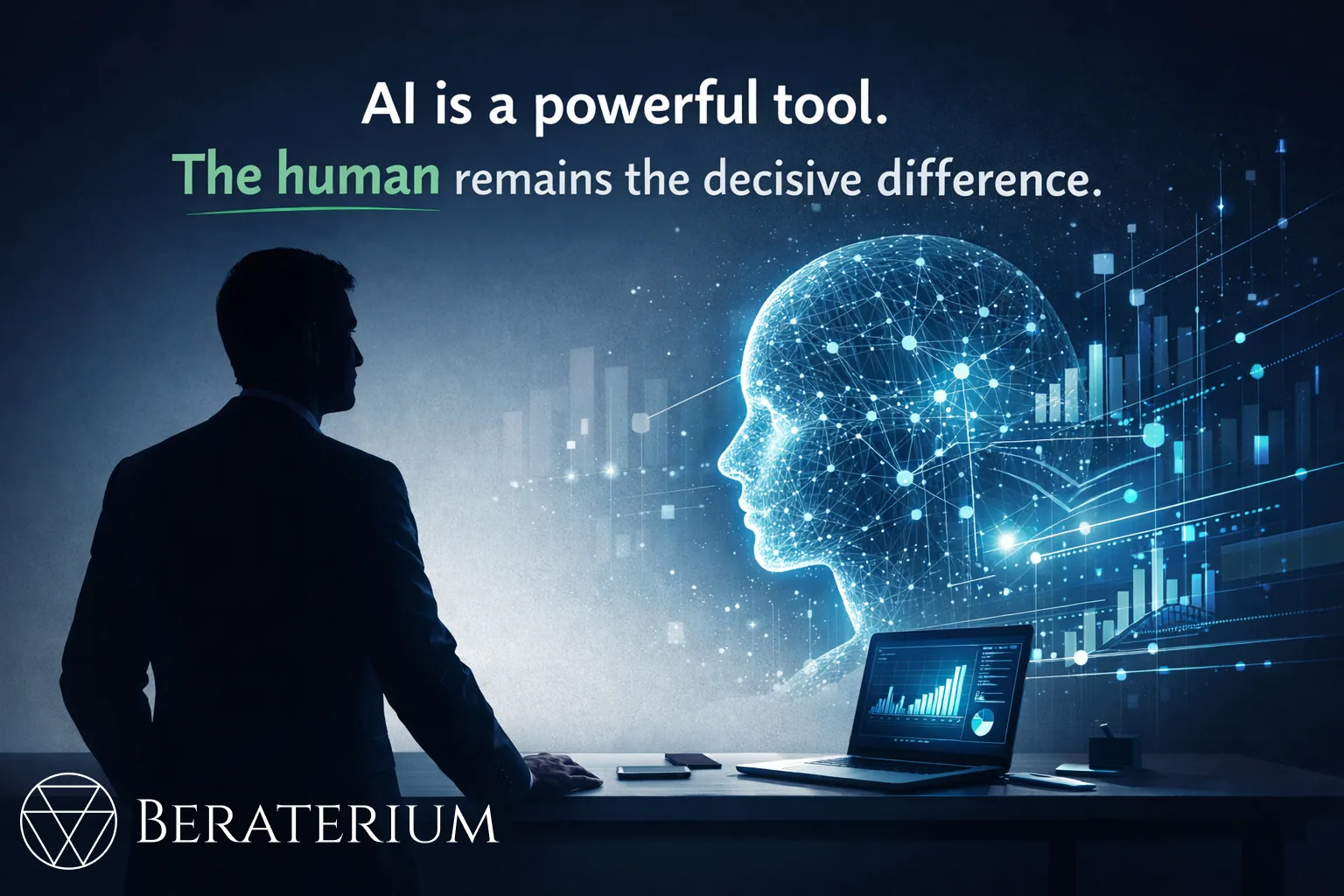
Reality is more nuanced. AI is a tool. Like a cordless screwdriver it does certain tasks faster and more evenly – but someone must know what the tool is used for and what should result. What AI (still) does not do: take responsibility, handle consequences, decide situationally, think creatively and "around the corner". Exactly for that you need thinking staff and leadership. Whoever only bets on automation and takes people out of the process loses precisely these strengths.
Where the biggest AI risks lie
Three areas are especially relevant:
1. The user as risk factor. In most cases risk arises not through AI itself, but through who uses it, how and for which processes. Whoever adopts AI results unchecked, has no grasp of the topic or has no clear usage rules increases the danger of wrong decisions and misinformation – in business as in private life, especially with young people and untrained use.
2. Data protection and GDPR. Processing sensitive data from customers, staff or processes in AI tools hosted e.g. in the USA can quickly lead to breaches. Consequences can be expensive and reputational. Before data flows into AI systems: check hosting, contracts and purpose precisely.
3. Intellectual property and reputation. AI can imitate voices, images and texts deceptively authentically. That opens possibilities for misuse – from fake videos to copying brands and people. Especially artists, brands and public figures must consider how to protect intellectual property and identity.
At the same time: AI is one important topic, but not the only one. Supply chains, people leadership, utility networks (power, internet, water), IT outage or location risks can be the bigger drivers for a concrete business. Risk management stays holistic – and recognises that the person is the link between all topics.
Think processes through first – then deploy AI
A often-shared sentence puts it well: If you digitise a bad process, you still have a bad process. Whoever simply bolts "AI on" without asking whether the process makes sense or should be rationalised away wastes money and may create more risks than before.
For founders and SMEs this means: AI can strongly accelerate entry and day-to-day operation – from drafting emails to video editing to website and calculation. That should be used. But only for processes that really benefit the business and that you or your team can still steer and understand. Whoever introduces too many AI tools without someone to operate them and assess results swaps one problem for another. And: bad inputs do not become good results with AI. Quality of ideas and processes remains decisive.
Concretely: analyse how deeply AI matters for your business model. Involve people – they should shape change, not only suffer it. Check processes before digitisation. And keep the big picture: which risks (not only AI) matter most for you and your business?
Three sentences to take away
– AI is a powerful tool.
– People are and remain the decisive difference.
– Risks arise where both are not thought through together.
Risk management does not mean hyping every risk. It means separating wheat from chaff and starting with what really affects your business and situation – pragmatically, dialogically and with people at the centre.