

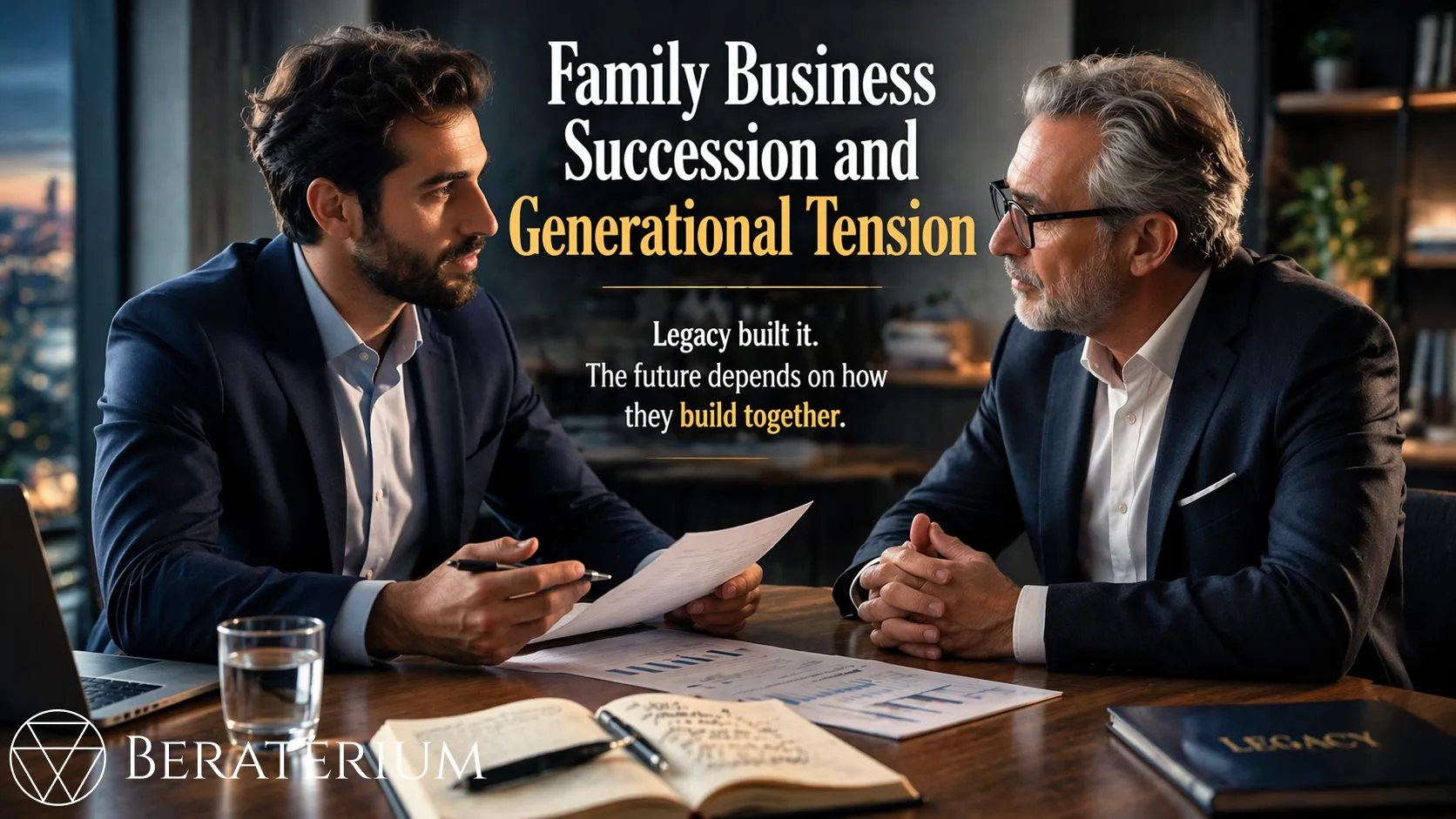
Why the conflict often sits "in the gut" although handover is formally done
Succession risks can be mapped structurally — see our business succession solution page.
Family businesses shape the German Mittelstand; at the same time many succession processes fail or are accompanied by hard conflict. What keeps appearing in media and advisory practice can be put in one sentence: it is not only about shares, contracts and tax, but identity, power and closeness. Whoever underestimates this looks for the cause of tension in the wrong place – and reacts with process optimisation or another workshop where roles, concerns and responsibilities actually need clarifying. For managing directors and successors, shareholder families and advisers in the Mittelstand, a look at the context pays off: which systems collide, which signals go to the team, which escalation paths are typical? This article places that in order – factually and without taking sides for "father" or "son", but with a clear risk perspective from Beraterium practice.
What exactly is "the context" in family succession?
The context is everything not in the notary protocol: how decisions are perceived, who feels heard, which fear of loss of control or of still being "the child at the table" lies behind things. It includes the question of whether the senior has a role that is valued after handover, or feels superfluous. It includes the successor's expectation finally to lead without every initiative being emotionally or informally taken back. And it includes the whole social field in the business: staff, leaders, customers and suppliers who very quickly notice when two interpretations of the same topic circulate internally. Exactly this context often decides whether friction becomes productive tension – or organisation and family suffer damage at the same time.
Why do family and business systems so often collide?
Family business advisory often works with two logics that do not behave "wrong" or "right", but have different rules. In the family system, closeness, belonging and the wish for recognition are typically central; equal treatment and emotional loyalty play a large role. In the business system, hierarchy, performance, clear responsibility and the ability to decide uncomfortably dominate. When the same person speaks sometimes as father, sometimes as shareholder, sometimes as former boss, ambiguity and hurt expectations arise for the other – because it is unclear which system is "in session". For succession conflicts this is central: the successor answers not only a specialist question, but often a whole history of authority, care and implied loyalty. The senior hears in the successor's proposal not only strategy, but sometimes devaluation of what took decades to stabilise.
What lies psychologically behind seniors' fears?
Many founders identify strongly with the business; the company is described like one's own child, with crises gone through together. Letting go then means not only less operational responsibility, but grief, loss of control and worry about losing self-image. Research on family businesses also highlights psychological ownership: emotional attachment, need for control and the feeling "that belongs to me". This bond is dynamic; letting go is cognitive and emotional work. Typical concerns are fear the life's work will be "driven into the wall", loss of influence and recognition, shame or self-doubt about the handover decision, and the unclear question of which role one has after withdrawal. If the senior reacts with increased interference, that is often a protective attempt for business and self-worth – not automatically mere power play. Whoever moderates from outside should make this motivation visible without taking sides.
Why does the successor push back – and why is that not "disrespect"?
Successors often stand in a diffuse transition role: externally legitimacy as managing director should be there, in the family field expectations, history and sometimes the child role continue. Management literature describes a paradox of control attempt by the older generation and autonomy need of the younger; ambivalent emotions add – respect and frustration side by side. Strategies range from adaptation to confrontational assertion when one's own leadership legitimacy is permanently questioned. Studies on emotional support from parents suggest genuine support through self-efficacy and commitment strengthens willingness to take over; if it is missing or replaced by constant correction, inner tension grows. In short: the successor often fights not against the person father, but for clear responsibility and recognition to decide as an adult.
Do both sides have a point – without one having "the truth"?
From a business view, preservation and renewal are both legitimate logics. The senior brings experience with crises, relationships and long cycles; often high risk sensitivity fed by decades of responsibility. The successor brings impulses for market, technology, culture and new target groups; plus the legitimate claim to autonomy after formal handover. Friction between tradition and innovation can be productive when it is led – e.g. through clear decision rules, timelines and transparent priorities. When it is not led, productive tension quickly becomes a front where every decision by the other is read as attack on one's own narrative: "You destroy what I built" versus "You won't let me work."
What can go wrong when change comes too radically or uncoordinated?
A common pattern is trying to modernise "everything at once": organisation, IT, people, sales – in parallel and without sufficient resources or communication. That leads to operational breaks because the system does not come along. Customers and partners often interpret sudden course changes without clear message as instability. Investment without consistent prioritisation strains liquidity and raises financial risks. Internally factions form: "old team" versus "new team", reinforced when staff know the senior still "listens in" informally or takes influence. Emotionally coupled ownership images also make rational prioritisation harder; then technical and human topics become inseparable in negotiation – which slows and poisons decisions.
What happens when the senior keeps interfering permanently?
Permanent interference – even if meant as "only advisory" – undermines the managing director's authority because staff orient to the stronger or more familiar signal. Decisions are questioned, partly reversed or double-coordinated; the course becomes zigzag. In the family system hurt, silence or open escalation grow; that is often harder to repair than a classic business dispute. In advisory interviews it keeps appearing: whoever constantly comes into the business and comments without a clear role creates two bosses in effect – with all consequences for pace and trust.
Why are staff often the first to suffer – and an early indicator?
When nobody knows who counts, chain of command and pace suffer. Decisions delay; loyalty to senior or successor forms informally. High performers seeking clarity demotivate or leave; that hurts especially in smaller organisations because replacement is scarce. Externally the market often smells internal discord earlier than assumed – through rumours, changing contacts or contradictory statements in sales and service. That is not a "side stage", but operational and reputation risk together.
Which worst cases are realistic – beyond family romance?
First: name difficult feelings and concerns explicitly – ideally separate from operational day-to-day business, so family and company are not the same meeting. Second: define joint decision rules: what does leadership decide alone? What belongs in a family council or advisory board? What needs a shareholder resolution? Third: integrate senior knowledge structurally – e.g. as mentor, in a fixed specialist field or in scheduled sparring sessions – without operational double steering. Fourth: give the senior security through transparent KPIs, risk management and realistic time horizons; that reduces projection of worst cases. Fifth: hold one line internally and externally: who is contact, which direction applies, how changes are communicated. Trust comes from reliability of the message, not from glossing over.
What helps in practice before fronts harden?
On the business side, economic damage, strategic paralysis, unsettled lenders or parallel competing projects are typical escalation stages. In extreme cases sale under pressure, value loss or years of litigation threaten – publicly discussed again and again as warning examples. On the family side, lasting estrangement between those involved, spillover to partners, siblings and the next generation, and inheritance and shareholder conflicts that echo for decades. Whoever treats this as risk instead of mere "mood" decides earlier for structure – and often saves both: money and relationship.
When is a neutral third party worth it – and what should they not do?
When conversations always land in the same circle or every clarification is immediately emotionally overlaid, facilitation, mediation or a professionally mandated advisory board typically bring impartiality and structure. The third party should not "crown a winner", but translate between family and business logic and help avoid loss of face. The earlier such support starts, the greater the chance usually to limit damage in both systems. Conflict coaching for individuals can make sense when clarity in one's own role understanding is missing first. What remains decisive: clear mandates and a shared goal – namely functioning responsibility instead of permanent feud.
Conclusion: clarity first, then measures
Generational conflicts after family succession are rarely "character weakness", but often the result of overlapping systems, unclear power and emotional attachment to the business. Whoever addresses the context early – roles, signals to the team, decision paths – reduces the risk of standstill, faction-building and external trust loss. Preservation and renewal do not contradict in principle; they become dangerous when negotiated at the same time and place without shared rules. At Beraterium we see this consistently: robust solutions begin with clarity, not the next big initiative.
Sources
– Praxisfeld: Succession in the family business (family vs business system, roles)
– Handelsblatt: Family firms—the company as part of the self (identity, involvement)
– WELT: Failed handovers—emotional dimension
– Radu-Lefebvre & Randerson, SAGE Journals: Paradox of control and autonomy in succession
– J. Peters Consult: Succession—from conflict to opportunity
– Ocorian: Emotional ownership in family businesses
This article is a factual framing from an advisory and risk perspective; it is not legal, tax, or therapeutic advice.