
Why talk about intellectual property and patent protection now?
Whether startup or established Mittelstand: ideas, brands, processes and staff knowledge are often the core of the business. At the same time not everything is legally protectable – and even where it is, protection applies only where you register it. Whoever thinks internationally (sales, production, suppliers) must think early about patents, trade marks and handling know-how — and assess risks through risk management consulting. This episode covers the basics: what is patentable at all? Where do risks around intellectual property lurk? And what can companies do – beyond contracts?
What is patentable – and what is not?
A patent protects technical products or processes: machines, tools, chemical processes (e.g. pharmaceuticals), technical improvements. A pure trade mark or utility model is something else – as are design (form, appearance) or copyright (e.g. texts, graphics). Important: in Germany the author often remains the creator, even if the company has usage rights; in the USA copyright can transfer to the company. That can matter in international collaboration.
Patent protection eventually expires (typically 20 years). After that anyone can theoretically use the process or product – familiar from medicines such as ibuprofen or paracetamol. Companies then often adapt formulations or applications to retain protection. For founders and SMEs this means: create clarity on what is protectable (trade mark, domain, technical patent, utility model) and what is not – and use other levers for the non-protectable.
International: protection only where registered
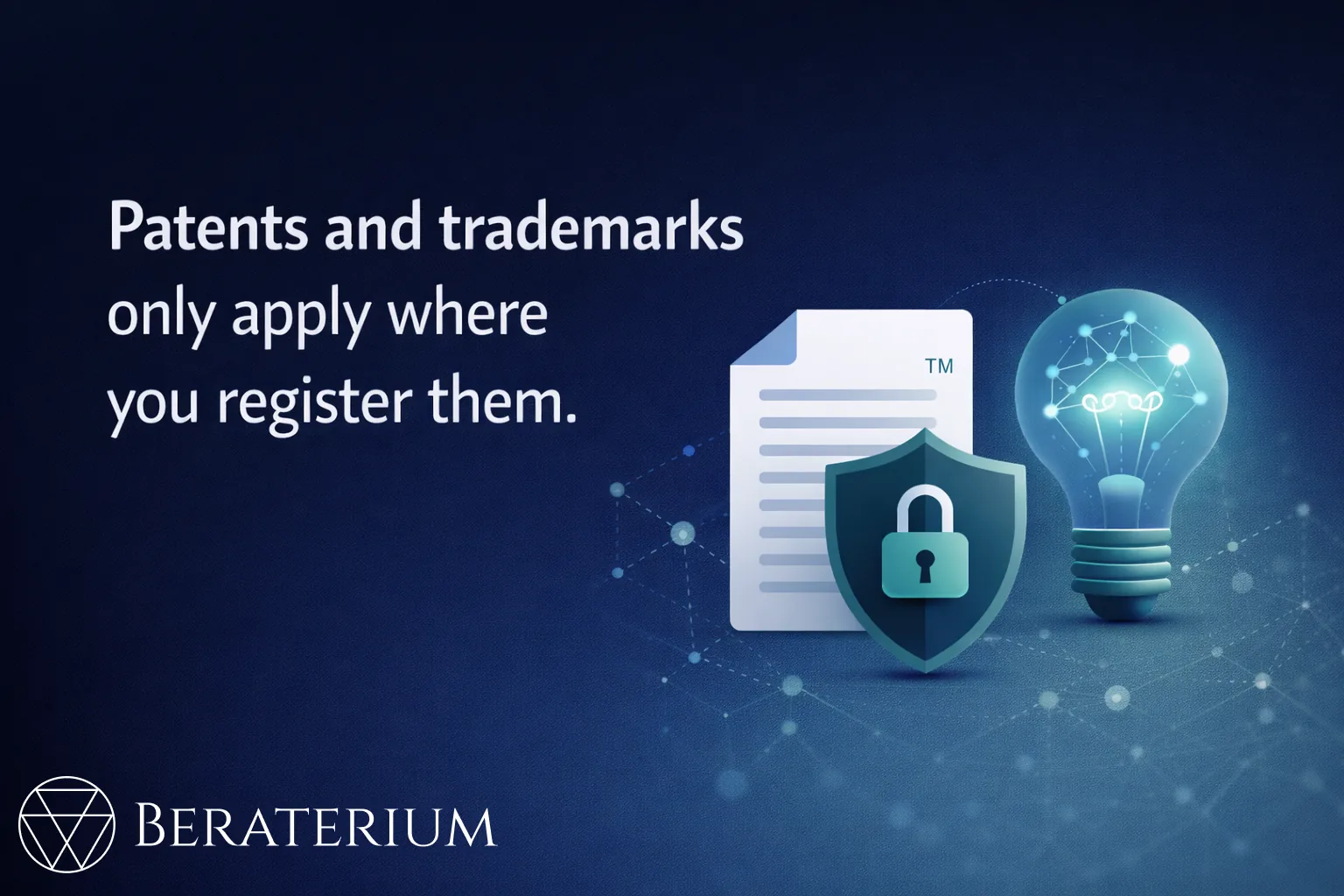
A patent or trade mark applies only in the country or region where you register it. Whoever protects only in Germany or the EU risks: others can register the same trade mark or patent in China, the USA or elsewhere – the patent specification is public. If you expand later, someone can make you buy back your "own" protection right. Especially with physical products produced or copied in China (or similar markets), it pays to have trade mark or patent protection there. Then you can act in the local legal system against producers or fakes, instead of only reacting in the EU. It costs – global patent protection quickly runs into high six figures – but targeted registration in key markets can make the difference for smaller brands.
Know-how leakage: NDAs, contracts – and the limits
Many valuable things are not patentable: internal processes, formulations (if not protected as a process), certain know-how, "how we do things". Here non-disclosure agreements (NDAs) and contractual clauses (e.g. non-compete) are a first step – sensible for both sides, also with business partners. However: having rights and getting rights are two different things. Enforcement costs money and nerves. It also pays to think organisationally: who documents what? Who has access? Are there clear rules for knowledge and documentation?
Knowledge has a half-life – but the person is missing
When an employee leaves, they often take knowledge "in their head" with them. From the company's view two things differ: (1) Strategic know-how has a half-life – after some time in a new environment much is no longer current. (2) Loss of the person often weighs heavier: succession, onboarding, gaps in processes, missing documentation. If someone leaves without offboarding, a hole remains. Therefore: shape onboarding and offboarding consciously, plan handovers, document processes and key positions. Knowledge stays in the company and the change becomes manageable.
Culture and people at the centre
Where people are valued and work openly together, the likelihood falls that someone leaves out of frustration and actively harms the company – e.g. through bad-mouthing, passing information to competitors or poor reviews. Reputational damage from dissatisfied ex-employees is hard to recover, especially in tight industries or the startup scene. The "measure" is therefore not only contract, but culture and fair transitions. Then intellectual property / know-how leakage risk is often better managed than through purely legal safeguards.
5 practical tips at a glance
- Trade mark and patent protection in production and sales markets (e.g. China, Bangladesh) invest upfront if products could be made or sold there – otherwise others can register your brand or produce fakes without local consequences.
- Identify and document processes and process-critical staff (who does what, how), so knowledge does not sit in one person alone when people change.
- Culture where knowledge and people are valued – reduces departure out of frustration and active harm.
- Protect everything protectable (trade mark, domain, technical patents, utility models); for the rest: be faster and more innovative than competitors.
- Ensure knowledge transfer from experienced and older staff before they leave – otherwise not only "intellectual property", but experience and skills are lost.
Data – information – knowledge
It pays to distinguish: data (raw data, measurements), information (interpretation, relations) and knowledge ("how you really do it" – e.g. sequence, tricks). Knowledge is usually the most valuable and hardest to replace. That needs rules: who documents? who has access? how is it preserved? With patents: proceed with proportion – do not escalate every conflict, but act where it really matters for the company. And: think organisationally and technically, not only legally – can you actually afford and implement what you plan?
Innovation and structure often more important than patents
At the end of the episode the message: you can succeed with any good idea, even without comprehensive patent protection. What matters: being fast enough, having good processes, keeping competitive advantage and staying innovative. Examples: Pixar (innovation and continuous improvement), Apple (much "only" brand), Coca-Cola (recipe in the safe, no longer patent-protected). When competitors catch up, you are ideally already on the next version. For founders and SMEs: protect what you can – but do not rely on legal alone. Innovation, structure and planning are often the more important lever.