

Who offers risk management advisory for the mid-market?
Four provider types are in play for risk management advisory in the mid-market: large audit and advisory firms (the "Big Four"), specialised mid-market advisers such as Beraterium, insurance brokers and DIY within your own business. Which type fits depends on three questions: How large and regulated is your business? Do you need a certificate or an actionable outcome? And how much internal know-how and time do you have? If you still need the basics, they are in What is risk management?.
The most important difference is not price but output format: some deliver a certificate and a lengthy report; others a prioritised risk picture with concrete next steps. The table below maps the four types.
| Provider type | Fits for | Output format | Implementation support | Price level |
|---|---|---|---|---|
| Big Four / ISO advisory | Corporates, audit-regulated businesses | Certificate, extensive report | rare | high |
| Specialised SME adviser (e.g. Beraterium) | SMEs with 20–250 employees | Risk picture in euros, prioritised measures | yes | medium |
| Insurance broker | insurable individual risks | policy proposal | policies only | low (commission-based) |
| DIY | micro-businesses, first collection | internal list | – | time instead of money |
When does Big Four or ISO 31000 advisory fit?
A large audit or certification adviser fits when your business has a formal audit duty, reports into a corporate group or when customers and tenders explicitly require ISO 31000 or equivalent certification. Then you need the demonstrable standard and documented methodology – and you pay accordingly.
For most mid-market businesses without certification pressure, however, this route is oversized. A corporate framework often produces more documentation than an SME can maintain – and still does not answer the real question: where is our greatest damage threat, and what do we do first?
When does a specialised mid-market adviser such as Beraterium fit?
A specialised mid-market adviser fits when you have 20 to 250 employees, no certification obligation, but genuine interest in ability to act instead of a folder on the shelf. The Beraterium method takes corporate risk management logic and translates it affordably and clearly for the mid-market.
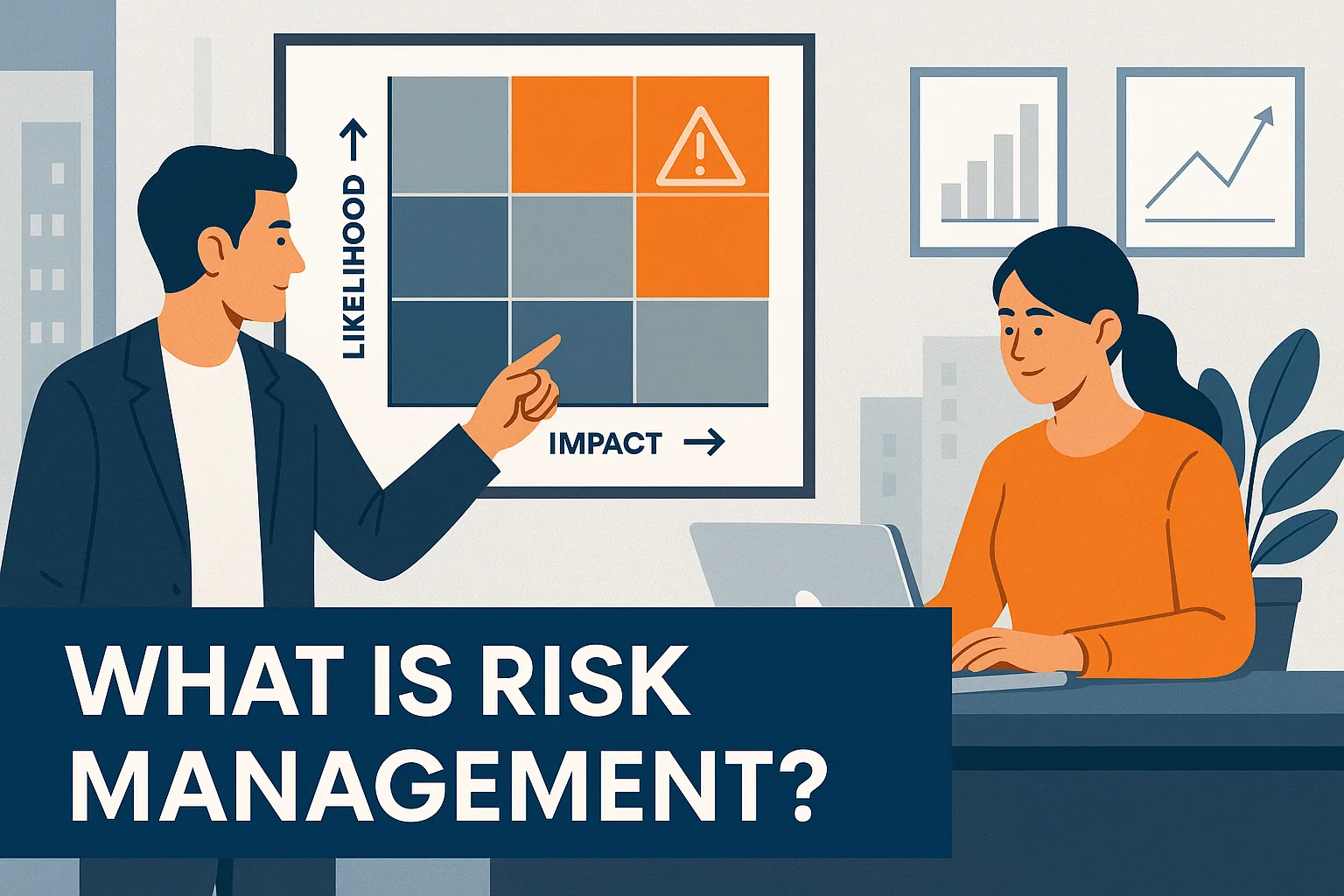
Concretely: the three-tier hazard catalogue collects hazards systematically; each risk is assessed in euros – damage amount and probability of occurrence instead of traffic-light colours – and from that comes prioritisation of the few most effective measures. For the mid-market there is a dedicated offer: Risk analysis for SMEs. A related building block is Cash flow analysis as part of risk management, because liquidity risks are often the underestimated gap.
When is an insurance broker enough?
An insurance broker is the right address for insurable individual risks – fire, business interruption, cyber policies, liability. They sell cover for risks that fit a policy and are usually paid by commission.
The limit: a broker views your business through insurable products. Many of the most dangerous mid-market risks are not insurable – loss of a key person, customer concentration, a failed succession or strategic misjudgements. An independent risk analysis therefore complements the broker instead of replacing it: first build the full picture, then decide which parts to insure.
When is DIY acceptable – and where is the limit?
DIY is acceptable for the first step: sit down with your leadership team and collect what could go wrong. That initial hazard collection costs only time and sharpens awareness.
The limit is operational blindness. The most dangerous risks are almost always those you no longer see because they belong to daily routine. Without a structured method, assessment is also missing: a list of 50 hazards without euro assessment does not say where to start. That is where an external view makes the difference – not because you do not know your business, but because an outsider sees the blind spots. More on why a systematic approach to risk protects the mid-market is in Security in business: risk management for SMEs.
How do you recognise a good risk management adviser for SMEs?
Regardless of provider type, quality shows in three traits. First: they assess risks in concrete euro amounts instead of vague colour scales – only then is it comparable which risk really counts. Second: they prioritise. A good adviser gives you not 80 measures but the few that prevent the greatest damage. Third: they support implementation instead of disappearing after the analysis – because a report on the shelf reduces no risk.
A fourth signal is honesty about their own role: a good adviser also tells you when a broker or certifier would be the better choice. Anyone serving every customer the same standard package is not thinking from the risk outward.
What does risk management advisory cost in the mid-market?
A reliable figure exists only after scope, but the order of magnitude can be placed: large certification projects quickly sit in the high four- to five-figure range; specialised mid-market advisory significantly below; and a first hazard collection in DIY costs only time. The most economically sensible entry is almost always a focused risk analysis: it shows which measures are worth it before you invest in software, policies or certificates.
Beraterium additionally backs this with a double guarantee – if we find no relevant risk or the analysis delivers no benefit, you pay nothing. Which option fits your business is best clarified directly: in a free intro call, 30 minutes, no obligation.