
Risk management is more than damage avoidance – it is the art of recognising uncertainty, assessing it and steering it deliberately.
In this article we explain the basics: what is a hazard? How does a risk arise from it? And why is understanding probability of occurrence and magnitude of damage decisive for business success?
With clear definitions and practical examples we show how risk management helps create clarity, set priorities and build long-term security and stability — including risk assessment in euros instead of traffic lights.
Hazards, risks and opportunities – how companies gain clarity
Risk management often sounds like complex tables, standards and theoretical models.
In truth it is about something very concrete: clarity about what can happen – and the ability to handle it confidently.
Those who understand risks can steer them. And those who can steer them create security, stability and room for development.
Risk management is therefore not a box-ticking exercise but a tool for making companies fit for the future – regardless of size or sector.
Hazard, risk, probability of occurrence and magnitude of damage – the basis of all risk management
A hazard initially describes only the possibility that an event – whether a technical fault, human error or external factor – can disrupt or change normal operations in the company. It is the potential trigger.
A risk only arises when you combine this hazard with two further factors:
- its probability of occurrence – in other words, how likely it is that the hazard will actually occur,
- and the magnitude of damage – in other words, what concrete consequences arise if the event actually occurs.
That gives the fundamental formula of risk management:
Risk = probability of occurrence (of the hazard) × magnitude of damage (after the hazard occurs)
Magnitude of damage describes how strongly an event affects the organisation – financially, organisationally or reputationally.
That can be expressed in measurable metrics such as revenue loss, downtime or additional costs.
Probability of occurrence, meanwhile, estimates how often or how easily a hazard can occur – for example annually, monthly, weekly or daily.
It is not about exact mathematics but a realistic assessment based on experience, data and observation.
The risk matrix – clarity through comparison
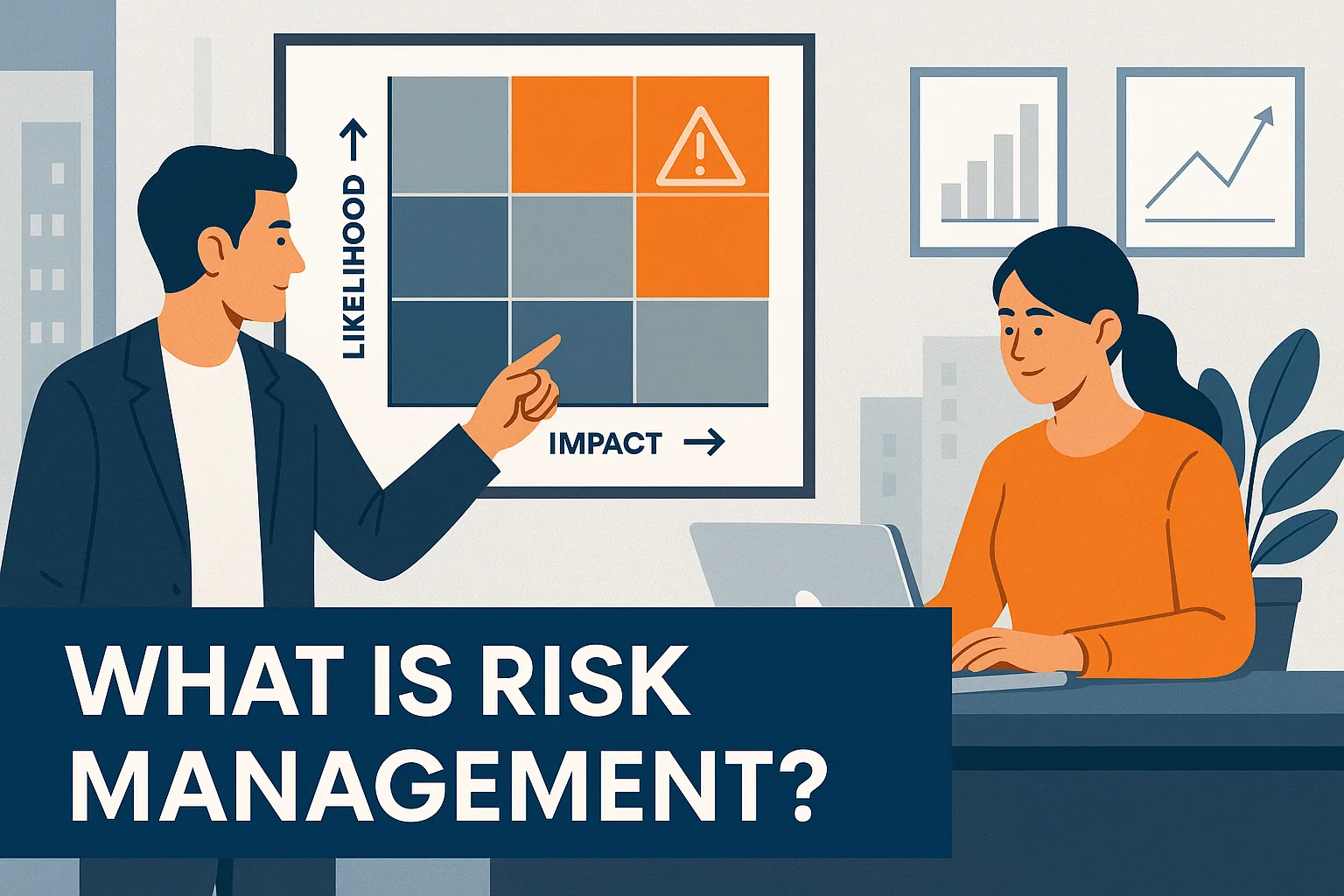
A central tool of modern risk management is the risk matrix.
It serves to compare different risks systematically.
Each risk is placed in a matrix along two dimensions:
- magnitude of damage (how serious would the consequences be if it occurred?)
- and probability of occurrence (how likely is it that the event will occur?).
This two-dimensional view allows risks to be assessed, categorised and prioritised.
That creates a clear overview of which threats are most relevant to the company – those that are either especially likely or would have especially high impact if they occurred.
The risk matrix is therefore not a theoretical diagram but a practical tool for making sound decisions:
which risks must be addressed first?
where is investment in prevention or cover worthwhile?
The risk portfolio complements the matrix by listing all identified risks by priority and reviewing them regularly.
That turns risk management into a living process – transparent, traceable and always aligned with the company's actual needs.
Why ISO standards matter – but often are not enough
ISO standards are international standards intended to help companies structure their processes in a structured and traceable way.
Examples include:
- ISO 9001 for quality management,
- ISO 27001 for information security,
- ISO 45001 for occupational safety and health protection,
- and ISO 31000 for risk management.
These standards offer clear guidelines, defined workflows and traceable documentation requirements – a major advantage for large organisations with complex structures, audits and reporting duties.
Yet especially in the mid-market and smaller companies weaknesses also show:
the procedures are often too extensive, too formal and too slow to be used flexibly in dynamic day-to-day operations.
Instead of fast decisions, bureaucracy often takes centre stage.
That is why at Beraterium we rely on a practical, understandable approach that respects the core principles of ISO standards but translates them in a simplified, application-oriented way.
The goal: less paper, more clarity – and risk management that does not only work on paper but is genuinely lived in everyday life.
Conclusion: clarity creates security
Risk management is not a control instrument but a navigation system for companies.
It shows where hazards lurk but also where opportunities arise – and how both can be kept in balance.
Those who know their risks can act boldly instead of only reacting.
And that is what it is about: not being afraid of risks but understanding them – and mastering them confidently.
📈 More insights and practical tips are available in our "Risk Radar" podcast – where Till Blania and Peter Münstermann talk every week about the most important foundations, methods and examples from practice.