
Risk is part of your entrepreneurial routine – whether you want it or not
The first step is a clear picture — our services overview shows which check fits your situation.
Risk in your company is not an exceptional state but everyday reality: regulation, energy prices, CO₂ requirements, skills shortages, cyber attacks and human error sit at your table every day. The decisive difference between growing and stagnating companies is not who has fewer risks, but who sees them earlier and steers them more consciously.
Many entrepreneurs hope that "it will be fine" instead of making risks visible and addressing them systematically. Precisely this naivety – when setting up a GmbH and suddenly being unable to withdraw money, or when scaling an agency without preparation – turns manageable threats into existential problems.
Why risk begins in the mind – not in technology
Most people, when they hear the word risk, immediately think of machines, IT systems or fire protection – in other words technology. In practice, however, most damage arises through people: missing maintenance, bypassing safeguards, incorrect operation, sloppy processes, unclear responsibilities.
People perceive the same risk radically differently. A new employee at the punching machine has enormous respect; the old hand waves it away – both stand before the same machine but with completely different inner films of experience, conditioning and emotion. The same applies in the office: for one person old software "still works"; for another it is an uncalculable cyber risk.
As long as you define risk only technically, you miss the biggest lever: involving people, using their perspectives and understanding their patterns. Risk management is always cultural work too – and it does not stop at the workshop door.
The invisible bridge: private risks in the company
Your people do not leave their private lives at the factory gate or on the video call lobby screen. Relationship stress, sick children, financial pressure, care responsibilities – all of that sits in the meeting even when nobody speaks about it.
For you that means:
- Unfocused employees are not automatically "bad"; they often carry unresolved private issues into the company.
- Your own private risks – financial risks, family matters, health burdens – affect your leadership quality and decision-making ability.
When this is not talked about, risk escalates quietly: employees resign "suddenly", high performers withdraw internally, teams function only on autopilot. In the podcast this process is aptly compared to a divorce: problems are ignored until someone leaves.
Mature risk management therefore always addresses communication too: who talks to whom? Who dares to raise critical topics – in the team, in one-to-ones, in leadership?
From gut feeling to risk strategy: knowledge instead of fear
The turning point in dealing with risk is a change of perspective: away from diffuse fear ("something could happen") towards precise knowledge ("this is how high the possible damage is, this is how likely it is, this is how I respond"). Once you know threat and impact, you are halfway there – the rest is shaping.
An example: a web services provider runs into a staff bottleneck because order volume rises but the team does not grow with it. The risk is clear:
- New enquiries cannot be accepted.
- Existing customers are poorly served.
- Regular customers do not return.
From that arise directly measurable damage: lost revenue, refunds, loss of lifetime value. At the same time a planning framework emerges: how likely is this scenario? In what timeframe? How high is the potential damage?
Precisely this knowledge creates the budget for countermeasures: targeted recruiting, thoughtful onboarding, process optimisation. Instead of hectic last-minute hiring, a scalable system emerges – the risk becomes a growth opportunity.
Practical framework: how to turn risks into opportunities
For risk not to remain abstract, you need a clear, repeatable approach. The following framework summarises the steps described in the transcript into entrepreneurial practice.
- Make risk visible – without glossing over it
- Think from maximum damage: imagine the risk has already occurred – server failure, production stop, key employee gone, data protection incident.
- Then ask yourself: what does it cost me? Revenue, reputation, productivity, nerves?
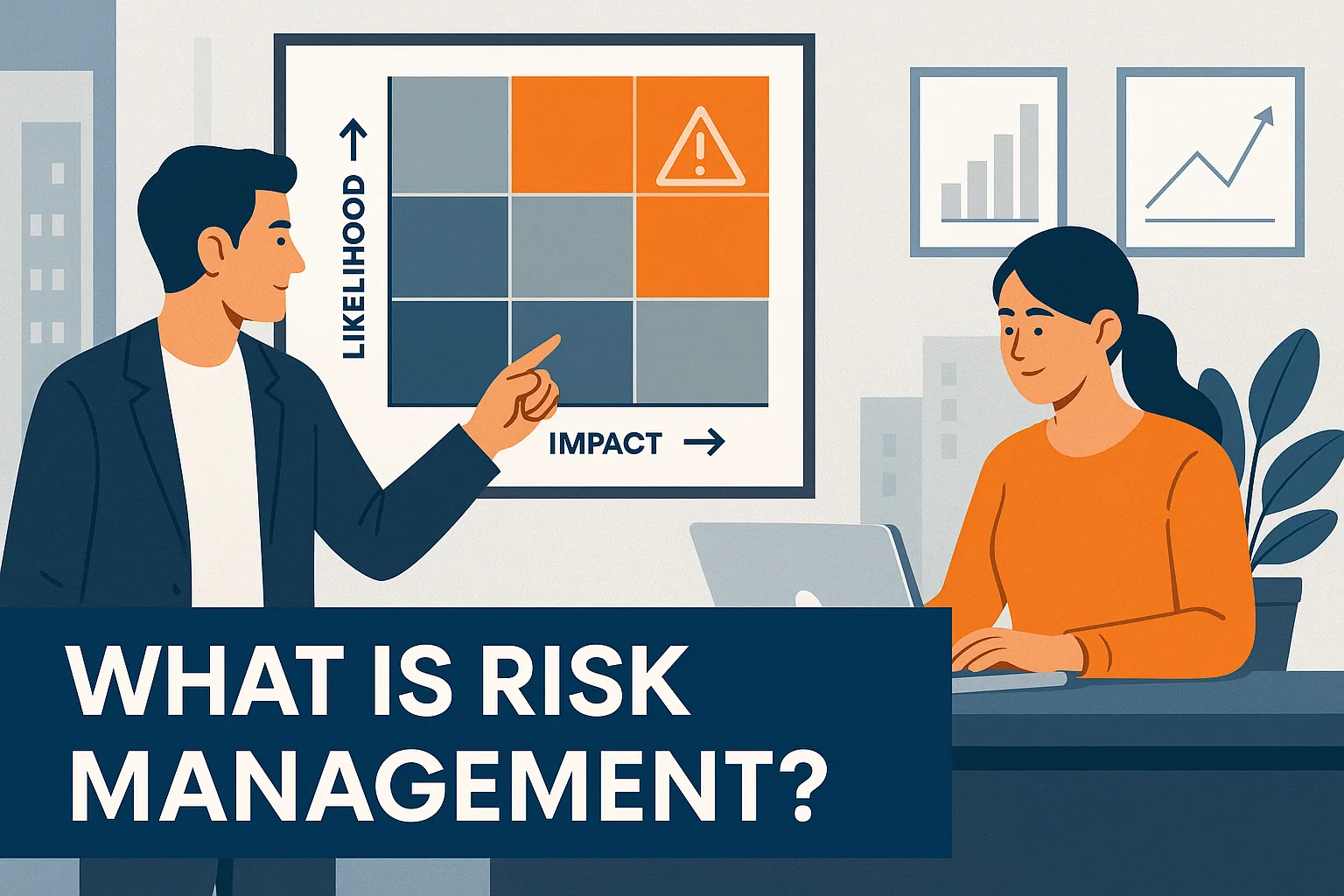
Now assess probability: is it more likely tomorrow, in six months or hardly at all? Only this combination of damage and probability makes the risk steerable.
- From list to strategy
Many companies record risks but remain stuck in Excel. It becomes mature when you actively build risks into your company strategy: - People risks become the foundation of your recruiting strategy.
- IT risks lead to clear role and permission models in your applications.
- Regulatory risks (energy, CO₂, environmental requirements) force you to modernise processes – and that is precisely where your competitive advantage lies.
Concrete start: your 360° risk check in four steps
Step 1: 360° walk-through – as if you were a stranger
Walk through your company as if you were neither boss nor employee: through production, warehouse, office, IT, fleet. Look consciously with "fresh eyes": where do you see bottlenecks, safety risks, dependence on individuals, process breaks?
Step 2: Conversations with key people
Then sit down with your area leads: production, warehouse, HR, IT, finance. Put your observations on the table and ask simple questions: "What has already happened to you there?", "Where do you see the greatest danger?", "What is it already costing us today?"
Step 3: Look at figures and damage
Get the last damage cases from finance: failures, rework, complaints, contractual penalties, refunds, lost hours. Compare these facts with your observation list – where both overlap lie your real top risks.
Step 4: Prioritise and improve experimentally
Focus on the 3–5 risks with the highest damage × probability. Develop a first measure for each: a better process, clear responsibilities, an IT audit, a pilot project in recruiting, a workshop with the team. You do not have to solve everything at once – but you must start shaping instead of hoping.
IT, cyber and applications: risk in the digital backbone
A striking example in the conversation is old business applications: access rights nobody understands any more, data that "disappears", systems without updates on which critical processes run. The risk ranges from data loss and business interruption to liability issues in data protection breaches.
The opportunity lies in applying the same principles as with people risk:
- Define risk clearly: what can this application do in the worst case?
- Estimate probability of occurrence: how often have we had incidents, warning signs, "odd" access?
- Derive measures: modernisation, clear role and permission models, four-eyes principle for critical functions, orderly replacement of legacy systems.
That turns diffuse IT unease into a concrete modernisation plan that makes your company more robust, faster and more attractive to skilled workers.
Shaping risks instead of suffering them: leadership as the core task
Risk only becomes manageable when you accept it as a leadership task – not as a tiresome duty or a job for specialist departments. The methods described in the transcript only work if you involve people, want to listen and are willing to form strategies from uncomfortable truths.
You essentially have three options in dealing with risk:
- Ignore: keep hoping nothing happens – until it becomes expensive.
- React: only act when damage has occurred – hectic, costly, stressful.
- Shape: recognise early, assess soberly, derive opportunities, build structures.
The final minutes of the conversation put it well: risk is not a monster that threatens you but a companion you can make visible and put to work for you. That is mature entrepreneurial attitude in uncertain times.