
Why health is missing from founders' and SMEs' risk registers
Key-person risk hits founding teams especially hard — the 4-week startup risk check addresses dependencies early.
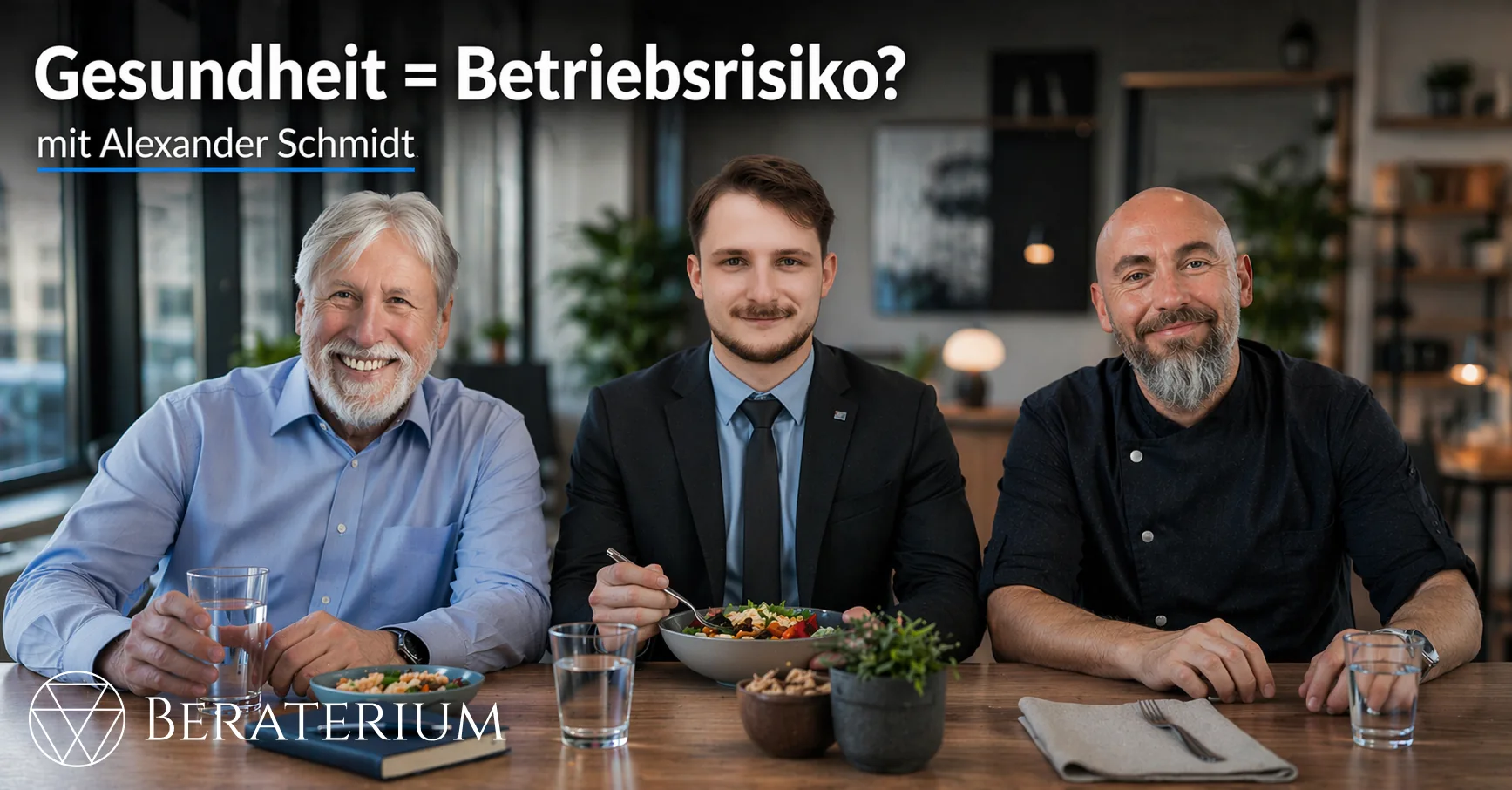
Risk management lives on impact and probability – and that is exactly where the physical and mental resilience of founders, managing directors and key staff belongs. In episode 16 of Risiko Radar, Till and Peter with guest Alexander Schmidt make clear that health is not a private "nice-to-have" beside the company, but links directly to delivery capability, deadlines and decision quality. Many startups and small Mittelstand businesses run the early phase on high intrinsic energy; exactly that phase deceives because it delays the view of slow fatigue, irritability and loss of concentration. Whoever takes the topic seriously only when someone is absent longer steers too late and often too expensively.
What happens to performance and decision quality when the body slowly falls behind?
Alexander describes a typical pattern: first "full throttle" still works, later come afternoon slumps, cynicism in situations where you normally stay composed, and small overreactions towards customers or in the team. Performance does not drop from one day to the next, but in small steps – so small that you rationalise them away and instead demand even stricter morning routines, more discipline or more meditation. Exactly there the guest sees the wrong lever in the podcast: when the system is already signalling, look first at basics such as sleep, recovery and nutrition before tightening tuning at the margin. For risk managers and managing directors this means: take early indicators seriously, not only late symptoms.
How does nutrition so often end up under the table in founding phases?
Peter puts the everyday experience of many self-employed people on the point: when the day lasts fourteen to sixteen hours, eating becomes a side matter – something you do "on the side". Alexander agrees and links it with a bigger break from the more common past: regional, seasonal, with more time for preparation and fewer highly processed products. Today quick snacks between meetings, sweet bites in appointments and business lunches where focus is on the deal, not the plate, dominate. Till adds from own practice that even those who cook and meal-prep can slip into exactly these gaps in stressful weeks. For risk assessment this matters because poor nutrition burdens not only long-term health, but short-term energy, immune system and mood – things immediately felt in operational day-to-day business.
Why "eating on the side" is more than a habit question
The conversation stresses that meals during meetings, in front of the laptop or parallel to series force the body into a split attention mode. Calories may be right, but from the guest's perspective it is also about quality of processing and whether the system can take the meal in as structured "information" – comparable to a file you install whilst distracted. This is not a plea for perfectionism, but for conscious breaks: short windows where eating is not only an add-on. For entrepreneurs this means concretely: protect the calendar, treat meal windows like small appointments and do not encourage teams to multitask every minute.
Celebrating, quality time and the role of attention
Peter asks whether it makes a difference to eat good food slowly and with appreciation – even if nutrients are identical. Alexander answers with the image of the kitchen as former family place and argues for quality time when cooking and eating: without phone, without second screen, with simple rituals that signal: now recovery and nourishment are due. That can scale; it need not be candlelight dinner. What matters is the stance. For leaders a sober consequence follows: whoever keeps staff permanently in a culture where "always reachable" and "no break" are normal undermines exactly this quality – regardless of which catering is ordered.
Genetics, regionality and macronutrients – what the podcast means
Alexander explains that he also approaches nutrition through which macronutrient distribution (carbohydrates, fats, protein) fits one's own disposition – linked with the image that ancestors were regionally shaped over very long periods. He does not recommend a fad diet across the board, but adapting distribution to one's own system, analogous to the "right oil" in the engine. The cited evolutionary arguments (e.g. on gluten) are disputed in science and medicine and need individual assessment; useful regardless: individualise nutrition, observe tolerance, do not expect one-size-fits-all for heterogeneous teams. For risk analysis: health measures must fit the organisation – joinery, tax practice and tech startup have different load profiles.
Which team risks arise when health is systematically ignored?
In businesses of about five to fifteen people, every piece of the puzzle is often critical. If a key person is absent – e.g. just before a release – roadmaps shift, growth stalls, external partners lose trust. Short term you may still close gaps; long term costs for onboarding, know-how loss and missed market windows add up. The episode makes clear this is not an "HR topic", but a classic business risk with a measurable trail in schedule and finances.
What to do instead of symbolic politics – and how Beraterium places it
Peter describes that his own method addresses people's health in the company as risk – with the same formalism as other damage scenarios. At the same time he warns against measures that look good but do not bite when evenings and weekends run differently. Alexander names fruit baskets and filtered water as nice but insufficient if the overall pattern does not fit; he argues for context-sensitive measures (some movement and short mental breaks in office everyday life vs physically active craft businesses). Till and Peter add that advisory without fitting leadership culture hits limits – analogous to other risk topics where will to implement decides.
Which leadership culture makes health initiatives credible?
A recurring point is the difference between "staff replaceable" and "the team is the value of the company". Where leadership only swaps and deploys people, they feel like a number – that eats motivation and trust and makes any wellbeing programme incredible. Where leadership lives appreciation and shared responsibility, rules and habits can change much more genuinely. Alexander also stresses he does not want to preach: bans and moral lectures create resistance; small voluntary steps and enjoyment in moderation are more sensible. That fits the Beraterium line: name risks, work options – but not against the decision-maker's basic stance.
Five practical tips from the episode – without perfectionism
To close, Alexander summarises five tangible impulses: first, real food instead of highly processed "survival food". Second, take sleep hygiene seriously and protect sleep quality, even when not every night is ideal. Third, consciously laugh and allow relaxation – in the podcast with a pragmatic hint at a brief grin as stress reset. Fourth, daily a short, deep conversation with a trusted person so load does not stay unsaid. Fifth, time outdoors and contact with nature, e.g. barefoot on the grass, to wind down. Peter adds with humour that the fifth tip is in doubt to follow the first four consistently – which hits the important point: consistency beats single actions.
Conclusion: the person belongs in the same risk logic as time and money
The quintessence from episode 16 can be bundled for founders, managing directors and risk owners: health and performance are not private side costs, but probability and impact in the business. Nutrition, sleep, attention when eating and a culture where people are not thought replaceable are practical levers – not a substitute for medicine or therapy, but relevant for resilience and team stability. Whoever names risks early and adapts measures to the organisation's reality avoids expensive surprises – and that is classic, factual risk management.