
Anyone who wants to grow successfully as an entrepreneur cannot avoid an uncomfortable truth: without consciously taking risks, genuine growth does not happen. But that does not mean plunging blindly into the unknown. It is about the balance between security and progress – calculated decisions instead of entrepreneurial roulette.
The figures speak clearly. In Germany, 80 out of 100 startups fail within the first three years. Only 48% of all newly founded companies survive this critical phase. At the same time, 80% of German mid-market businesses expect accelerated economic contraction in 2025. Uncertainty is everywhere – and that is precisely why intelligent handling of risk becomes a decisive competitive factor.
The risk paradox: when security slows innovation
Conscious decisions need numbers — our method values residual risk in euros.
Many entrepreneurs face a dilemma. On one hand they are advised to minimise risk, secure processes and identify threats early. On the other, growth requires the opposite: opening new markets, developing innovative products, entering unknown territory. Those who only sail in safe waters will not reach new shores.
Current studies show that overly detailed, rigid risk management can actually paralyse a company's capacity to innovate. Research on enterprise risk management demonstrates that excessive control and complex safeguarding systems can negatively affect the speed of new product development. Innovation needs room for experiments – and therefore for calculated failure.
That does not mean risk management is superfluous. On the contrary. It is about finding the right dose. Those who want to cover every eventuality before the first decision is made lose valuable time and momentum. Those who rush ahead blindly risk not only their own company but also the livelihoods of employees and their families.
Why entrepreneurs really fail
The problem is not risk itself. The problem is the lack of clarity beforehand. Entrepreneurs do not fail because they take risks – they fail because they take risks they have not understood. Wrong information, gut feeling under pressure, hope instead of sound analysis – those are the real killers.
Think of a surgeon. They too take risks with every operation. But they minimise them systematically. They calculate them precisely. They cushion them through preparation, experience and contingency plans. Entrepreneurs should think in exactly the same way. Not like gamblers, but like strategists.
The responsibility weighs heavily. 62% of German mid-market businesses currently fear they will not be able to fill their apprenticeship places. 40% have already recorded revenue losses. In this situation, nobody can afford to take uncalculated risks. At the same time, nobody can afford to stop acting out of fear of mistakes.
The four-point framework for conscious risk-taking
How do you strike the balance? How can entrepreneurs take risks without acting irresponsibly? The answer lies in a structured but pragmatic approach – a framework that creates clarity without stifling innovation.
Step 1: Identify risks and make them visible
The first step sounds simple but is often skipped. What risks am I actually taking? With every new project, every investment decision, every product launch, possible dangers should be consciously named. Not every detail needs analysis – but worst-case scenarios must be on the table.
Current data show that only 31% of German SMEs conduct regular risk analyses – and the trend is falling. Yet precisely this transparency is the foundation of every sound decision. Those who do not know their risks cannot steer them.
Important: do not only think about obvious financial risks. What could go wrong in the supply chain? How dependent am I on individual customers or suppliers? What happens if a key employee is absent? These questions may be uncomfortable – but they are necessary.
Step 2: Estimate and assess risks
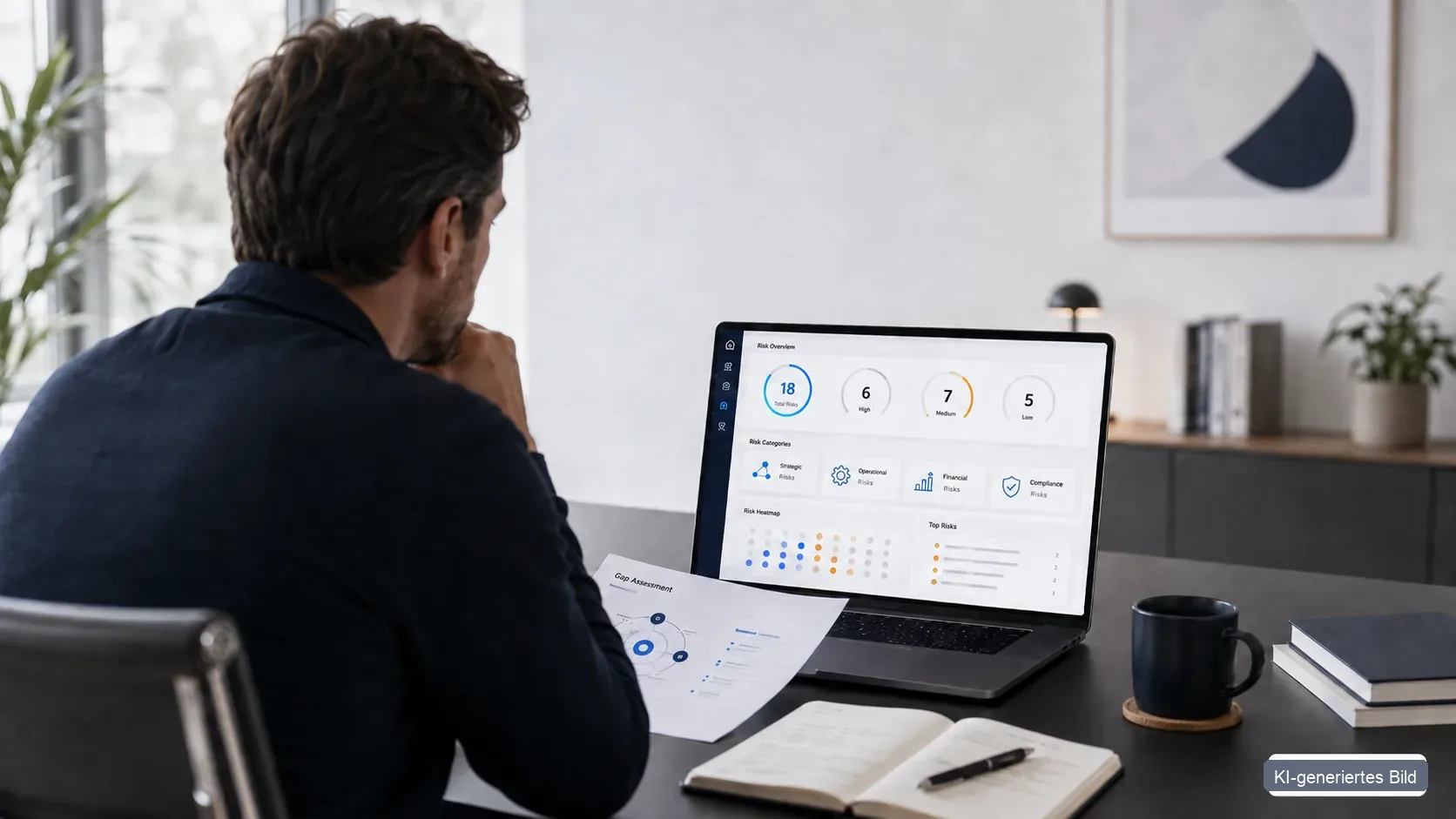
Once risks are identified, assessment follows. How likely is it that this risk will occur? And how severe would the consequences be? A simple risk matrix helps: probability on one axis, impact on the other.
The financial aspect plays a central role. How much could this risk cost? What does that mean for my liquidity, my reserves, the stability of the company? The answers do not need to be exact to the penny – but the order of magnitude must be clear.
Equally important: non-financial consequences. What does it mean for company culture if a project fails? How do employees, customers and partners react? In Germany, 59% of companies believe cyber attacks could threaten their business existence. Mere fear of risk can already undermine trust and motivation – which is why clarity is needed instead of diffuse worry.
Step 3: Take measures to cushion risk
Now it gets concrete. How can I cushion the identified and assessed risks? There are several starting points:
Build reserves: it sounds trivial but is often neglected. Those who consciously take risks need financial buffers. Not every risk has to materialise – but when it does, the company should not immediately face collapse.
Review insurance: especially for existential risks such as cyber security, business interruption or liability issues, insurance can carry a substantial part of the burden. 70% of all economic damage in Germany is now caused by digital attacks – an area that requires professional cover.
Bring in external expertise: only 8% of German mid-market businesses involve external consultants when building their risk management. That is surprisingly low. Often it is precisely external perspectives that reveal blind spots and draw attention to risks overlooked in day-to-day operations.
Small steps instead of big leaps: where possible, risks should be broken into manageable portions. A new product? First test it as an MVP with a limited budget instead of ramping up full production straight away. Opening new markets? Start with a pilot project, learn from experience, then scale.
Step 4: Prepare contingency plans with recommended actions
Perhaps the most important step. What do I do if the risk actually occurs? Too often this point is neglected. The risk is identified, perhaps even assessed – but there is no concrete plan for the worst case.
Working through worst-case scenarios sounds pessimistic but is highly professional. If the new product flops – what then? If the major customer pulls out – what options do I have? If the cyber attack comes – who is responsible, what steps follow in what order?
These plans belong in the drawer. Nobody hopes to need them. But when the emergency arrives, there is no time for hectic improvisation. Then clarity counts. Then it matters that action steps are prepared and everyone in the team knows what to do.
Entrepreneurs who consistently work through these four steps can take larger risks with a clear conscience. They know what they are doing. They have worked through scenarios. They are prepared. That is the difference between gambling and entrepreneurial responsibility.
People at the centre: responsibility beyond the numbers
Risk management is not a purely technical discipline. It is about people. Every entrepreneurial risk affects not only balance sheets and cash flows – it affects employees' livelihoods, their families, their future.
This dimension is often underestimated. When an entrepreneur makes a risky decision out of misplaced ambition or under pressure and it goes wrong, it is not machines or numbers that suffer. It is people who lose their jobs, whose trust is shaken, whose financial security is endangered.
The German mid-market has a particular tradition here. Many entrepreneurs go personally liable, and in extreme cases even sell private assets to save the company and secure jobs. This commitment, this responsibility, is a value that goes far beyond short-term profit maximisation.
Younger founders who have grown up in the digital startup world can learn from this attitude. Fast growth matters, scaling matters – but not at any price. Companies are built for the long term, with values, with responsibility, with a view to the next 20 years, not just the next quarter.
Risk as a shaping instrument, not a threat
In the end there is an insight that initially sounds paradoxical: those who truly understand and manage risk no longer experience it as a threat, but as a tool. Consciously taking risks becomes a strategic decision – not a necessity to which you are helplessly exposed.
Companies that have internalised this attitude are more resilient. They do not only react to crises; they anticipate them. They plan not only for the best case but also for the worst. And in doing so they create exactly the freedom innovation needs: the security that even when things fail, the foundation remains stable.
The balance between risk and security, between growth and responsibility, is not a formula that can be calculated once and for all. It is a constant weighing, a continuous process. But those who make the four steps – identify, assess, cushion, prepare – routine will find this balance more and more often.
Summary: the key insights
Three central points remain:
First: those who want to grow must take risks – but never blindly. The difference between successful and failed entrepreneurs lies not in risk avoidance but in intelligent risk management.
Second: risks only become manageable when they are understood. Identification, assessment, safeguarding and contingency planning are not bureaucracy – they are the foundation of responsible action.
Third: risk management is not a purely technical discipline. At its core it is about people, responsibility and trust. Every decision has consequences that go far beyond numbers.
The next step: from knowledge to action
Those who have understood these principles face the decisive question: how do I put this into practice? How do I bring structure to my risk management without stifling innovation? How do I create clarity for myself and my team?
The answer does not lie in complex systems or extensive manuals. It lies in pragmatic tools that work in everyday life. In workshops that involve employees instead of patronising them. In risk portfolios that show at a glance where the greatest dangers lurk – and where the best opportunities lie.
If you want to go deeper on this topic, we discussed it at length in our podcast. In episode 9 we go further into the balance between risk appetite and responsibility and show concrete examples from practice. Listen in and find out how other entrepreneurs handle exactly these questions.
Risk is not an adventure. Risk is a tool. And those who master it have a decisive competitive advantage.