
Why a community for risk management?
The Risk Radar community connects founders with vetted experts — alongside risk management consulting.
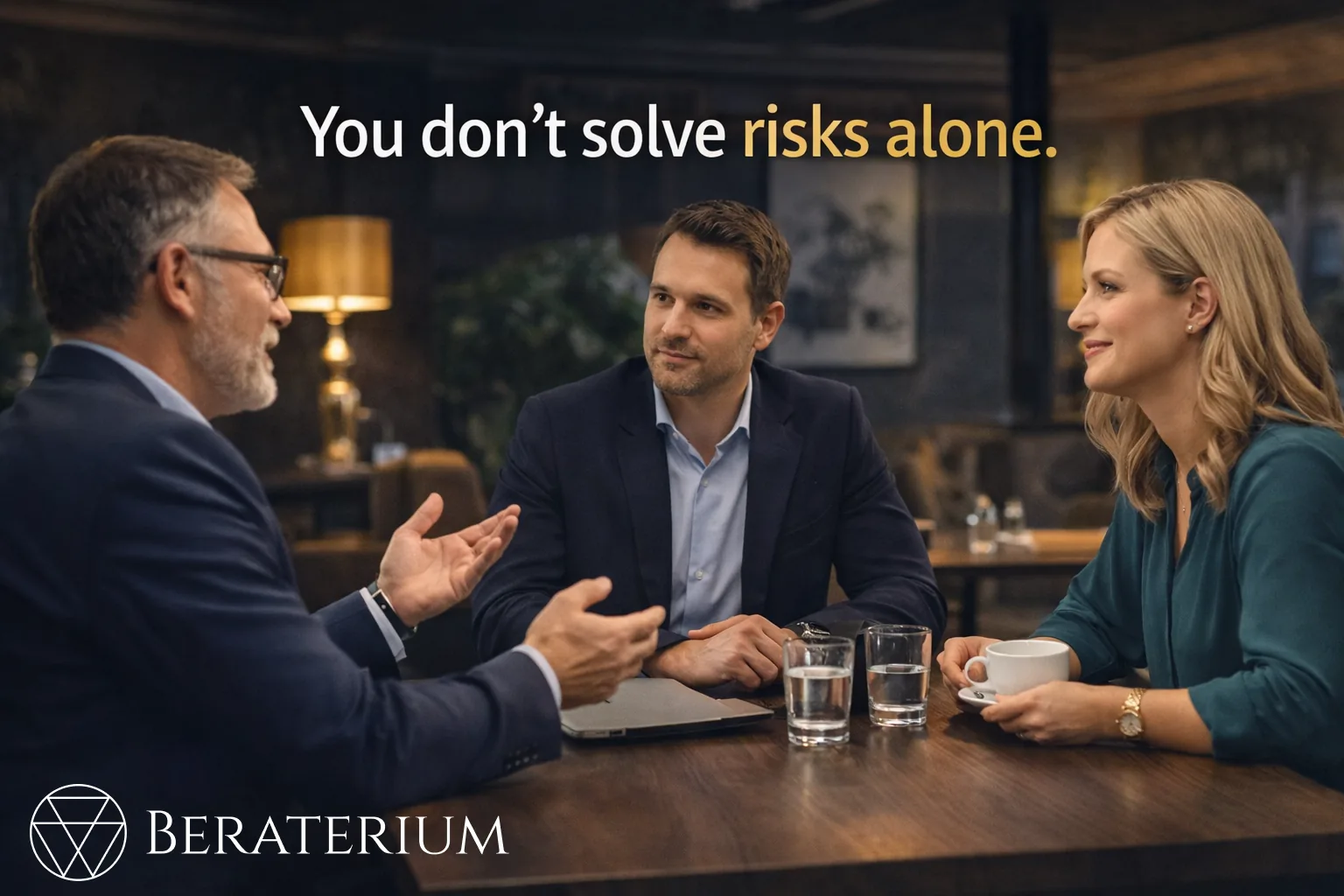
Anyone who engages with risk management knows the first step: identifying and assessing risks methodically. At Beraterium we have made precisely that our mission – finding the biggest risks in small, mid-sized and large companies, perhaps the top five. Fine, that is done. But then comes the real challenge: what do we do with them now? Measures are needed. And the conviction behind the Community Risk Radar is simple: a single consultant or expert may perhaps cover 80%, but there are always edge areas where they need support or discussion with others. Whether IT problems, occupational safety, people management or GDPR – a single coach will rarely get everything right alone. That is why the logical next step was to create a platform where all expertise is bundled and customers and interested parties find a real home.
A closed space instead of a public forum
Unlike Facebook groups, public forums or LinkedIn discussions, the Community Risk Radar is a closed space. Why? In public groups there are many silent observers who only watch and take away, but contribute little. You have to "play" the medium and keep people engaged – that is not the purpose. The Community Risk Radar has club character: there is a reception, you sign in, you become known. Only those who are registered may participate. This principle secures quality, trust and constructive collaboration. No network marketers recruiting 20 more people. No silent lurking without contribution. Instead a protected space focused on solving problems.
Experts for every field – a network becomes visible
Behind Beraterium are Till and Peter, each bringing their own expert networks – from founder support and programming to project management and IT security. Together that forms a huge network for all possible fields. Until now this network was loose; the experts were there, but not directly visible or reachable for customers. The idea of the community is to gather these experts in one place where everyone can get to know each other, exchange views and build trust – before concrete collaboration begins. The goal: when someone becomes a customer and joins the community, they find the right contact for every identified risk. Staff bottlenecks? Cash flow problems? IT security gaps? For each of these threats there should be an expert who can help – or a small team that works out a solution together.
Measures need teamwork: time, cost, acceptance
When we talk about measures, we are automatically dealing with three factors: time, cost and acceptance. A set of measures can include technical elements (e.g. occupational safety), employee awareness and organisational workflows – that is not a solo effort. Added to that: companies have often already done a lot – certifications, walk-throughs, internally trained staff. We want to use this existing expertise, not replace it. When the boss says, "I have someone for IT, someone for GDPR, someone for AI", those employees are welcome in the community too. Together with external experts and the founders of Beraterium, a "large family" emerges that is available 24×7 – asynchronously, calmly, without a rigid meeting calendar. And when a risk has been addressed once, the result serves as a blueprint: another company with the same risk can learn from it, the two companies can exchange views. Not everything has to be bought in externally.
Networking in a protected space – and the limits of social media
In a business context, networking is essential. But in Facebook groups or on LinkedIn you hit limits: you do not always get an answer, you do not always reach the right contact, and there is often no protected framework for genuine professional exchange. The Community Risk Radar is meant to provide that framework – with people who want to network, share their experience and contribute actively. Those who know BNI (Business Network International) for comparison: there the core is 1-to-1 referrals. That has value, but it assumes one person can solve the problem alone. As a rule, however, risks are interconnected – they are networked and cross-disciplinary. The Community Risk Radar therefore relies on networked problem-solving: several mosaic pieces come together, two, three, four or five people work on a solution. The common thread is always the human factor – business is done between people, not between organisations. And "the star" is the problem that needs solving.
Exchange instead of pitch – collaborative business
The community is not a marketplace for sales events. It is about exchange and problem-solving. Sometimes it is only a small question, a brief uncertainty for which you need an expert opinion – and you get that in conversation with the community. Sometimes a deeper collaboration emerges from it. Of course the community should also be a space for business – but on equal terms, in a friendly way, as collaborative business. Not "what can you do for me today?", but "how do we solve this together?". There will be expert calls where members present what they are especially good at – but not as a sales pitch, rather as a professional impulse: what is at stake in the topic, what are the dangers, what needs attention? There are many solutions – the question is what really fits together.
Not only CEOs – for everyone who wants to solve problems
The community is not aimed only at managing directors or CEOs. It is aimed at everyone interested in risk management and problem-solving: assistants, finance, sales managers, production managers, IT experts from the company. It is about bringing together those who have problems and those who can solve them. Anyone with time or interest is welcome – even if the boss themselves "has no appetite for this sort of thing".
How do you get in? The next step
The Community Risk Radar has existed for about a month and is not yet open to everyone. Further members will be admitted shortly – via a personal 1-to-1 conversation in which you get to know each other: what do you envisage, what do you want to achieve, where do you want to contribute, what do you bring, what are you looking for? Building trust, liking each other – that is the foundation. Those who are interested can arrange a conversation directly.