

What are the biggest risks for self-employed people and freelancers?
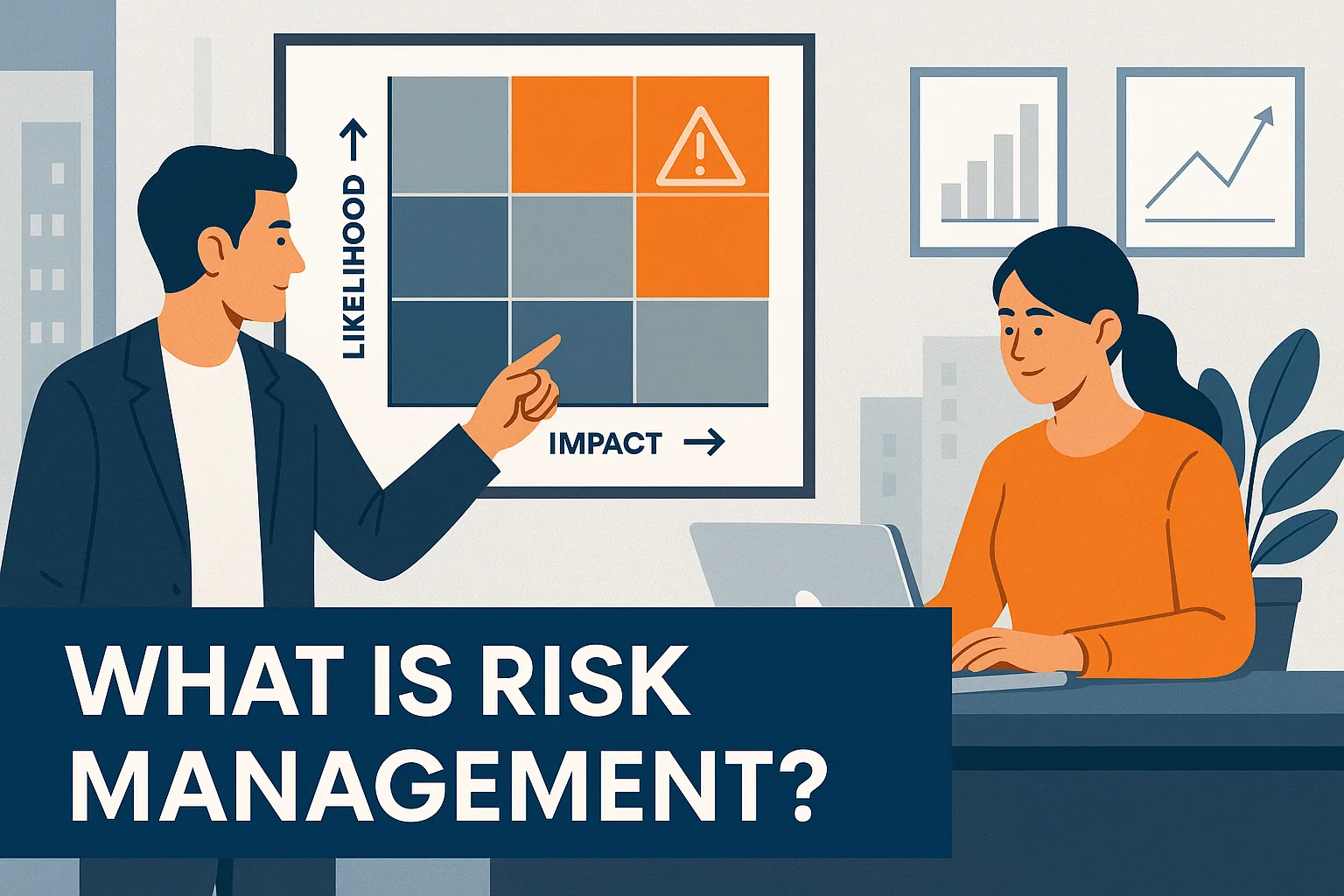
The three biggest risks for solo self-employed people are loss of your own capacity to work, customer concentration and false self-employment. All three share one thing: you carry them alone, without a team, works council or cover. That is what makes risk management for the self-employed so distinct – the basics are explained in What is risk management?. This article shows how to spot the three risks, what to do about them and who can help.
Why is outage risk the biggest risk of all?
As a solo self-employed person, you are the business. If you drop out – through illness, accident or burnout – everything stops at once: there is no continued pay, no colleague to take over, and fixed costs run on unchanged. Your own outage is key person risk in pure form.
The good news: this risk can be prepared for. A simple emergency plan (Who informs clients? Which projects have buffer? Where are access details?), sickness/incapacity cover and three to six months of reserves greatly reduce possible damage. Because your health is the most important asset here, it is also worth reading Founder health as a risk.
How do I spot customer concentration risk – and what do I do about it?
Customer concentration means too large a share of your revenue depends on a single client. The rule of thumb: from about 40% revenue share with one customer it becomes risky, because their termination immediately leaves a hole you can barely plug at short notice.
What helps is well known but uncomfortable: actively winning new business even when the order book is full; building recurring smaller clients instead of one large one; and setting payment terms so an outage does not immediately corner you. Important: quantify the risk before it hits – Taking risks consciously shows how to do that systematically.
What is false self-employment – and does it affect me?
False self-employment applies when you formally work as a freelancer but are actually integrated like an employee. Typical signs: one client only, fixed working hours, direction from the client and no independent market presence. The risk is substantial because the German pension insurance can claim social security contributions retrospectively over years.
As a rough guide: if more than about 83% of your revenue comes from a single client, you should seriously review your status. The number alone is not decisive – the nature of the working relationship is. In doubt, a status determination brings clarity – customer concentration and false self-employment are directly linked.
Who helps with protecting against these risks?
For individual risks there are specialists: an insurance broker covers insurable risks (occupational disability, sickness benefit), a tax adviser or specialist solicitor helps with status and contracts. What these individual advisers cannot do is the full picture: which of your risks weighs heaviest and what you should tackle first?
That is what Beraterium is for. Beraterium supports solo self-employed people with the 2-week risk compass: it systematically surfaces outage, customer concentration and false self-employment and assesses each risk in euros – with concrete next steps instead of a long to-do list. How that assessment works is shown in the Beraterium method; the matching offer is the 2-week risk compass for the self-employed; a compact overview is on Protecting yourself when self-employed.
What is the first step?
You do not have to solve all three risks at once. The first step is to make them visible: write down how much revenue depends on your largest client, how long your reserves would cover an outage and how many genuine clients you had last year. Those three numbers already show where your biggest blind spot lies.
If you then want a complete picture assessed in euros, we are happy to clarify that in a free intro call – 30 minutes, no obligation, no sales pressure.