

Why is men’s emotional health a leadership risk?
Because the man who carries the company is often the same man who wants to hold the frame at home — and pays for both with performance. When the relationship dies quietly, intimacy is not the only loss. Attention, sleep and decisions tilt. For risk management this is not a soft topic. It is key-person risk as soon as the carrier drops out or only still functions.
In Risk Radar episode 23 Marin Maric is blunt: career or love is the wrong fork. Both are possible — if you look before the house burns.
What does “the house is on fire” mean in the daily life of successful men?
It means the distance is already there. He may no longer live under the same roof. Dating feels like self-denial. Or the partner says in court the line many founders know: you were never there.
Marin works with entrepreneurs and executives on dating, relationships and separation. Most do not come for a check-up. They come when the pain is already real. In about three years of coaching — plus earlier side work — he counts around 100 men. Two arrived when there were only cracks. The rest arrived when it was already burning.
Same pattern as the doctor: ignore until hospital is unavoidable. Risk management calls that waiting for the loss. Beraterium translates losses into euros — a breakup with children, a war over the house, a missing managing director have prices. Whether you write them down or not.
Save the man, not the marriage.
Why do men fail when the job and the salary still work?
Because many hang identity on performance. Marin calls it the war-grandchild inheritance and provider mode: am I a good father and husband? Does the frame hold? Love is paid in house, dog and overtime — and still missing as presence.
Self-worth props sit outside: company car, title, the next salary. A client changed firm and received an Opel Astra in the probation period instead of the usual status car. He drove at night so nobody would see him. That is not a story about cars. That is a man whose sense of worth collapses without scenery.
High fixed costs also trap people in jobs that betray their values. Anyone who needs 150,000 euros does not halve that overnight. The hamster wheel is then not a character flaw. It is a system that makes warning signs expensive as long as you suppress them.
Which blind spots do men have around emotion?
Marin asks men to name ten everyday emotions. Most manage six or seven — of more than 170 he treats as the spectrum. If four of those are anger, grief, irritation, life runs on a negative baseline while the head wants peace.
Programmes until age seven: an Indian knows no pain. Don’t be a softie. So the doctor comes late, the relationship comes late, coaching comes late. Women often have earlier access via the body. That is not a moral club against men. It is an invitation to take seriously the same body they spend in sales and on site.
One man with Marin: every long relationship ended after four years. The common denominator was not “the wrong women”. It was a mother wound and nice-guy patterns — yes to things he does not stand for. Successful at work, empty in attraction. Not blame X — look at Y: the own pattern.
How do the job mask and private clarity differ?
Peter is right to ask: standing in front and motivating is not the same as an hour of dumping. Marin knows the mask from sales, in negotiations worth millions. Authenticity costs less than seven masks — the best known: the alpha who can handle everything. “How are you?” — “Fine. Must.”
Not every negotiation allows a confession. That is why a men’s community: brother from another mother. No revenue comparison. A dentist in Marin’s circle: the only one without a Porsche, the only one married more than 20 years. Correlation, not proof. Priority still visible.
Men often connect through doing, not through talking the way many women’s circles do. Anyone who tries to rebuild men as defective women misses them. Strength through a felt body — and through trustworthy men where nothing leaks backwards. Toxic teams need a clean cut, privately and at work.
Is masculinity toxic — or is the middle path missing?
Till names the trap: Andrew Tate hustle on one side, “become softer like women” on the other. Marin clears the frame: masculinity is care and protection when the man is with himself. Alpha coaching with status and women as objects is the opposite of his work.
Young men look for orientation in a society where fathers are often missing. Marin’s figure: every third child of a breakup loses a parent completely after twelve months — usually the father. That is his statement in the conversation, not an agency statistic. The direction stays: mentoring instead of a vacuum that charlatans fill.
And the line that polarises without feeding a gender war: what a woman says she wants and what creates attraction often fall apart. Light and shadow on both sides. Empowerment for women, clarity for men — both. Not against the woman. For the good of both.
| Pattern | When the house is on fire | When you prevent |
|---|---|---|
| Trigger | Breakup, sexless marriage, dating frustration | Cracks: no intimacy, chronic stress |
| Motivation | Pain (Marin: three to four times stronger) | Stance: take family and yourself seriously |
| Leadership | Mask, haste, orders by fiat | Self-leadership, calm, conviction |
| Relationship | Save her / beg her to stay | Clarify the man — then decide honestly |
| Company | Outage, bad calls, burnout | Key person stays able to carry |
What do depression, burnout and suicide have to do with self-leadership?
Uncomfortable and necessary. Marin: the male suicide rate almost four times as high. That is not drama for clicks. It is the price of an ignored cellar. This article is not therapy, not a doctor, not a crisis line. Anyone in acute distress needs professional help — now.
Marin names contributing causes from his practice: testosterone, in his view, about 30 percent lower than in men of the 1980s (a thesis, not a study cited here). Jobs without meaning. Porn loops. Loneliness in dead relationships and as a successful single. The home-ownership lie: the bank owns the rate, the façade owns identity. Burnout as always higher, faster — depression as a betrayed heart.
A psychologist on a Stuttgart corporate hotline, Marin says, is scaling up: fear of the future, main-earner load, men on the line. That is founder health as a risk in the harder variant. Anyone who only buys rhetoric seminars and never looks at the wheel of life tunes the engine and ignores the crack in the block.
Two questions Marin puts to men: What do I want to stand for? What do I want to go for? Kick-off slogans are not enough. A calling you would still do if the account were full — or an honest job that only pays bills, plus a plan not to lose yourself.
Which 20 percent separate a man from generic coaching?
Till says the impulses apply to everyone. Marin corrects: 80 percent of personal development is the same. The decisive 20 percent are masculine — perception, body, how success in relationship actually works. Otherwise every man could see a lifestyle coach. That puzzle piece is the game changer.
That is not superiority. It is difference without war. The same world in which heavy infrastructure jobs are still mostly done by men, often wrecking the body — not as patriarchy against women, Marin says, but for everyone’s comfort. Erase that and you erase responsibility. Praise only that and you erase vulnerability. Leadership needs both.
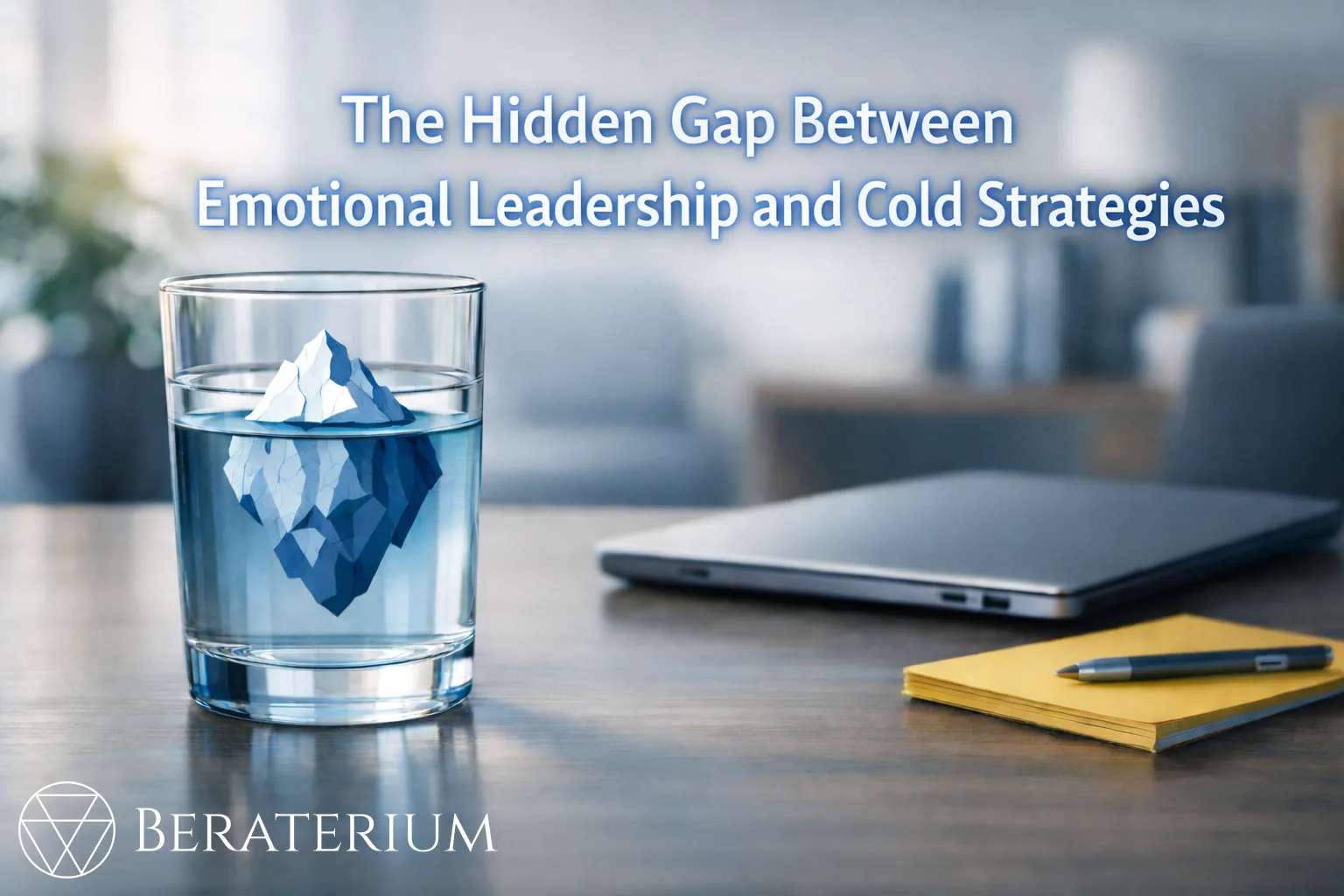
Emotional leadership in SMEs hits the same iceberg from the organisation side. Here it is the man who cannot name the iceberg in himself.
What can you do on Monday without waiting for the big crisis?
- Pay yourself first: The first 30 to 60 minutes are yours. Water, quiet, light movement — not inbox and everyone else’s needs.
- Ten emotions: An inventory without a victim pose. What runs all day? What keeps landing at your feet?
- Male friendship: A conversation that is not revenue. Swarm intelligence, confidentiality.
- Walk for an hour: Marin: look into the distance, nature — a valve deeper than the stadium and distraction.
- Eisenhower, honestly: Not only urgent and important. What becomes a deadline because you never touch it in time — the relationship included.
- Decision: Fight for the relationship from strength — or clarify the parenting roof for the children without clinging.
One of Marin’s rare early clients takes half an hour with his wife in the morning before the children set the tone. That is not esoteric. That is priority, visible in the calendar — the same discipline you give a quarterly target.
Conclusion: Not against women — first the man who leads himself
The central demand of this episode is simple and uncomfortable: we men have to look after ourselves too. Not only when the house is empty. Not by rebuilding ourselves as defective women. Not by making women the enemy.
Each person, themselves. Hold masculine energy. Name emotions without turning the mask into identity. Then something shared can grow — in the partnership and in the company. Postpone that and you drive key-person risk on a timer. Look, and gut feeling becomes clarity.
Next Monday: 45 minutes without a phone. Ten emotions on a sheet. One call to a man you trust. If the house is already on fire — get help, do not wait on hope.
This text is not medical or therapeutic advice. In depression, suicidal thoughts or an acute crisis: medical and therapeutic help, not only a podcast.
In conversation: Marin Maric
Marin Maric is a sparring partner for entrepreneurs and executives on dating, relationships and separation; a TÜV-certified systemic coach. Website: selbstbestimmtmann.de. Social: marin.macht.mann. Monthly digital men’s circle (DACH) and an in-person meeting on the last Thursday of the month, Klosterraum Stuttgart.